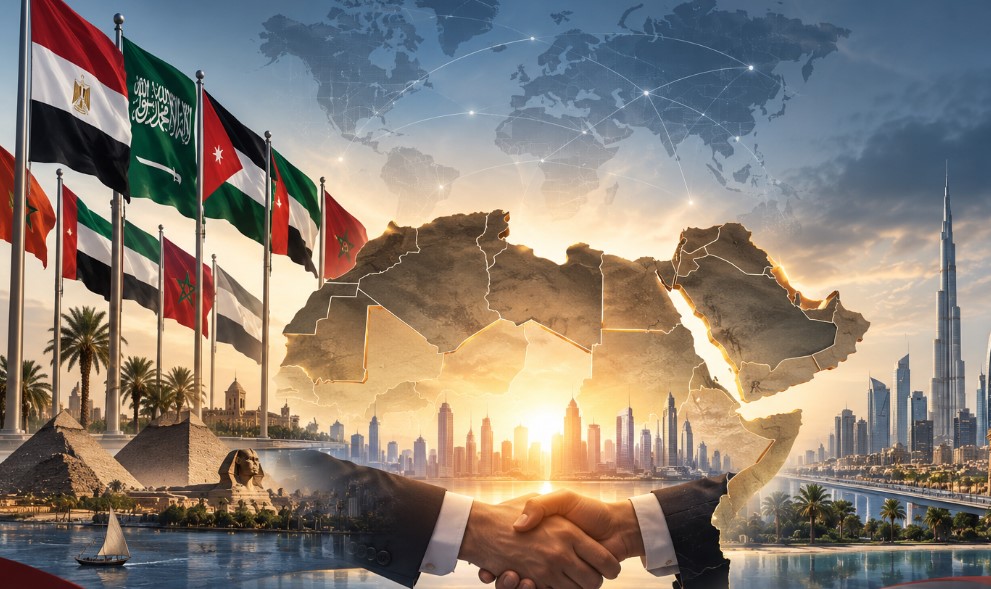
At times of major transformation, states redefine their interests before redefining their policies. The world is currently experiencing one of its most turbulent periods since the end of the Cold War: prolonged wars amid growing competition over trade routes, the reshaping of supply chains, economic sanctions, competition over energy and technology, and the rapid rise of economic and political blocs. In such an environment, a state’s ability to protect its economy and interests increasingly depends on its capacity to build a broad network of relationships and alliances that provides greater strategic options and a stronger ability to absorb external shocks.
This is where the need to rethink the concept of Arab integration becomes increasingly evident, moving away from approaches that have historically associated Arab cooperation with political projects extending beyond the boundaries of the nation-state or interfering in its internal structure. The Arab region does not need a formula that undermines the independence of its states or imposes a single political model upon them. What it needs is a clear project based on respect for state sovereignty and non-interference in internal affairs, while building an advanced level of economic and political coordination on issues affecting common Arab interests. This should be the starting point for any realistic vision of Arab integration in the twenty-first century.
The nation-state should be the political unit from which any modern Arab project begins. The strength of the Arab regional system will not come from weakening individual states, but from strengthening their ability to withstand shocks, grow, negotiate, and protect their interests. As Arab economies become more interconnected, each state becomes less vulnerable to external shocks, while the collective group of states becomes better equipped to withstand international and regional pressures. Integration in this context does not diminish sovereignty; rather, it adds economic and strategic depth to it, making national decision-making more resilient.
The Arab world possesses a vast market. According to World Bank data, the population of the Arab world exceeded 492.6 million in 2024, while its combined GDP reached approximately $3.7 trillion. These figures should fundamentally change the way the Arab market is perceived. Nearly half a billion consumers represent a substantial demand base capable of providing Arab products with significant room for growth and supporting investment in industry, technology, services, agriculture, transportation, and logistics if the region is treated as an interconnected market. The scale of the Arab market can also give local companies the opportunity to achieve greater economies of scale, reduce costs, and improve their global competitiveness.
The question that deserves serious consideration is: Why should an Arab manufacturer not be able to regard the entire Arab region as a natural market for its products? Why do some Arab countries continue to import goods that other Arab countries can produce efficiently? And why does Arab capital flow abroad in search of investment opportunities while major gaps remain within the region in industry, energy, food security, infrastructure, and technology? These questions lead to the heart of the problem. The issue is not so much a scarcity of resources as it is a lack of connectivity among the region’s existing sources of strength.
Some countries possess enormous capital and investment capacity; others possess natural resources and energy; some have strong industrial bases, while others have agricultural land and human resources. Some are strategically located along the world’s most important trade routes. When these elements are brought together within an interconnected economic system, the value generated can become far greater than the sum of its individual parts. One country may produce industrial components, another provide financing, a third contribute technology, and a fourth supply raw materials, after which the finished product can be exported to Arab and global markets. Borders then become points of connection within a unified production system, while the political sovereignty of each state remains fully intact.
The integration required can begin with practical steps: facilitating the movement of goods, reducing non-tariff barriers, developing logistical connectivity, harmonizing selected standards and specifications, encouraging cross-border investment, linking production chains, and developing Arab financing mechanisms for strategic projects. The experience of the Gulf Cooperation Council provides an important indication of the feasibility of such a path. The International Monetary Fund has noted that the share of trade in value added generated by intra-GCC trade increased from around 5% in 2005 to 15% in 2021. This development reflects a gradual shift from merely exchanging goods toward greater participation in the production of value itself.
The importance of this model becomes even greater amid global crises. Modern conflicts have demonstrated that economic security has become a direct component of national security. The disruption of a maritime route can increase transportation, insurance, and energy costs. A war in an agricultural region can affect global food prices. Sanctions can reshape trade and financial flows, while geopolitical instability can rapidly spill over into inflation, currencies, and investment. The Arab region has already paid a significant price for these transformations. According to data from the Food and Agriculture Organization, approximately 77.5 million people in Arab countries experienced hunger in 2024, while around 197.7 million faced moderate or severe food insecurity. Such figures make integration in food, agriculture, transportation, storage, and finance a matter of national security in the economic sense of the term.
This is where the importance of Arab political coordination also emerges. There is no need to unify the foreign policies of Arab states on every issue, nor to produce a single position on every international crisis. Each state has its own calculations, interests, relationships, and particular circumstances. What is required is to build a shared space for strategic interests: respect for sovereignty, rejection of interference in internal affairs, protection of Arab security, safeguarding trade routes, strengthening food and energy security, and coordinating positions when common Arab interests come under external pressure. This level of coordination does not diminish national decision-making; rather, it gives it broader regional depth.
Diplomacy, in this context, becomes an extension of economic power. A state with a limited market negotiates according to the size of its market. A group of countries representing a market approaching half a billion people, while possessing energy resources, capital, major trade routes, and an exceptional geographic position, operates within an entirely different negotiating space. Power in this case does not require confrontational rhetoric. Genuine influence emerges when others have a vested interest in maintaining their relationships with states integrated into strong economic blocs. The greater the shared economic interests among Arab countries, the greater their ability to negotiate from a more balanced position.
The relationship between Arab integration and national security can also be understood from this perspective. A regional vacuum never remains a vacuum. When Arab states do not offer a regional economic and political project based on development, stability, trade, and investment, other projects will emerge to fill that space. Some of these projects may carry political and security visions that conflict with Arab interests, seeking to expand their influence through economic relations, energy, trade routes, or the exploitation of internal divisions within the region’s states. Confronting such projects does not require entering into open conflicts with every regional actor. Above all, it requires building a strong Arab project capable of offering a more stable, efficient, and attractive alternative.
A strong Arab project does not need to attack competing projects in order to limit their ability to expand. It is enough to provide an alternative capable of creating opportunities, generating development, and strengthening stability. When there is an Arab energy network, a broader Arab market, Arab supply chains, cross-border investment, interconnected transportation corridors, joint food-security projects, and a financing and investment system capable of supporting major projects, the region becomes better equipped to protect its interests. The ability of competing projects to penetrate the Arab sphere consequently becomes more limited, because economies and societies have stronger and more effective Arab alternatives available to them.
The nature of international competition has changed. Military power remains important, and political power remains decisive, but the economy has become one of the most important sources of influence. Major powers increasingly use markets, investment, technology, supply chains, energy, and finance as instruments of foreign policy. In such an environment, it becomes difficult for Arab states to maximize their influence while treating their economic capabilities separately, particularly as the world is moving rapidly toward greater reliance on blocs and toward maximizing power through larger markets and integrated resources.
The coming phase requires a more mature Arab vision: strong nation-states with full sovereignty, cooperating on areas where their interests intersect, coordinating their positions where their collective interests are threatened, gradually opening their markets to one another’s products, connecting their infrastructure, investing their surpluses in building Arab productive capacity, and developing shared systems for food security, energy, transportation, and technology. This model respects and strengthens the nation-state while making integration a means of increasing negotiating power, promoting growth, expanding markets, reducing risks, achieving economic security, and building an Arab weight capable of influencing the international system.
Ultimately, the value of Arab integration does not lie simply in the fact that Arabs can become stronger by joining forces. It lies in the fact that the world itself has become increasingly dependent on blocs, while the Arab region already possesses the foundations of a major economic and geopolitical bloc. Arab states can preserve the independence of their national decisions while simultaneously relying on an economic and political environment that provides them with greater strategic depth. The Arab economy can evolve from a collection of neighboring markets into a network of mutually reinforcing interests, while Arab diplomacy can move from addressing crises individually toward coordinated positions on issues affecting common security and interests.
The question that will determine the position of the Arab world in the years ahead is not the scale of what we possess. We have long known that we possess considerable resources and capabilities. The real question is whether we possess the political and economic capacity to transform what we have into organized power.
If we succeed in doing so, the Arab state can enter the international system with greater resilience, greater independence in decision-making, broader markets, and stronger negotiating power. Arab integration would then become a project for the future rather than a dream of the past: a project that protects the nation-state by strengthening its economy, safeguards national security by building shared interests, and gives the Arab world a genuine capacity to move from merely being affected by international transformations to becoming increasingly capable of shaping them.