Egyptian-Russian relations have moved beyond the traditional understanding of bilateral relations governed by considerations of trade, arms, or short-term interests. These relations have become part of a broader process of reshaping regional and international balances, amid the international system’s transition from a phase of unipolar dominance toward a more complex order characterized by multiple centers of power and influence.
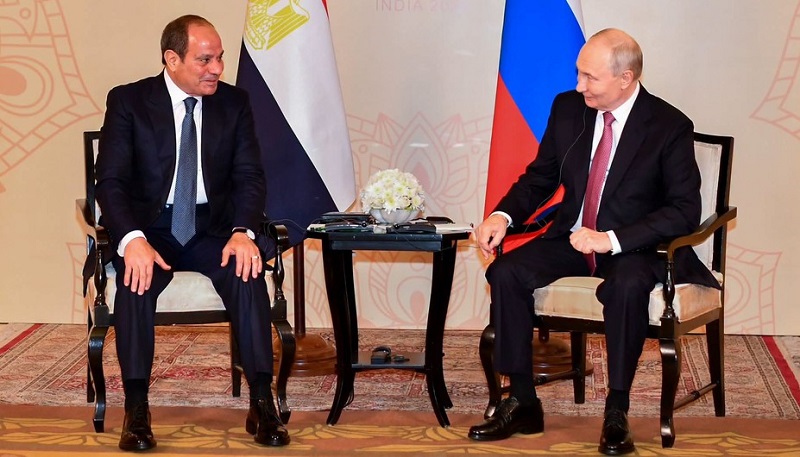
In this context, the meeting between President Abdel Fattah El-Sisi and Russian President Vladimir Putin on the sidelines of the 18th BRICS Summit in New Delhi, India, on September 11, 2026, carries particular significance. The meeting took place at a highly complex international and regional moment, shaped by the Russia-Ukraine war, tensions in the Middle East, the Iranian crisis, the war in Gaza, the crisis in Sudan, and disruptions to international trade and maritime navigation.
Therefore, the Egyptian-Russian meeting should not be assessed merely in terms of the issues discussed. Rather, it should be understood within the broader context of Russia’s position in Egypt’s vision of managing its international relations, as well as Egypt’s position within Russia’s strategy toward the Middle East and Africa.
Egyptian foreign policy in recent years has not been based on replacing one international partner with another, nor has it sought to build one relationship at the expense of another. Instead, it has been founded on a more pragmatic principle: diversifying partnerships, expanding the room for maneuver, preserving the independence of national decision-making, and enhancing Egypt’s ability to navigate a changing international environment. This is where the importance of Egyptian-Russian relations becomes particularly evident.
First: A Historic Relationship That Transcends the Current Moment
Egyptian-Russian relations date back many decades, but they acquired a clear strategic dimension during the 1950s and 1960s, when the Soviet Union became a major partner for Egypt in the process of nation-building, supporting the industrial base, and developing military capabilities.
The High Dam project was among the most prominent projects that embodied the nature of this period, alongside numerous industrial and electricity projects, as well as the Soviet role in training Egyptian cadres and developing Egypt’s military capabilities.
Throughout its modern history, Egypt has succeeded in reshaping its international relations without losing its ability to maintain channels of communication with different powers. From this perspective, the strong revival of Egyptian-Russian relations in recent years is not a temporary phenomenon, but rather an extension of a historical legacy that has been modernized to meet the requirements of the twenty-first century.
Second: Post-2014 — Rebuilding the Relationship on New Foundations
Egyptian-Russian relations received a strong boost following President Abdel Fattah El-Sisi’s assumption of office, as contacts, visits, and meetings between the two countries’ leaderships intensified. Cooperation expanded into defense, energy, trade, tourism, agriculture, investment, industry, and nuclear energy.
However, a realistic reading requires moving beyond the interpretation of this rapprochement as merely a reaction to a period of tension between Egypt and the United States. It is true that international relations after 2013 witnessed differences in perspectives between Cairo and Washington over a number of issues, and it is also true that this contributed to encouraging Cairo to broaden its international options. Yet the more important factor was Egypt’s recognition that the post-Cold War world no longer allows middle-sized states to rely on a single source of power or partnership.
Accordingly, Egypt’s openness toward Russia, China, India, the Gulf states, Europe, and others has become part of a broader Egyptian policy based on diversified partnerships.
This can be described in international relations literature as strategic hedging—that is, avoiding dependence on a single axis while maintaining balanced relations with different international powers in a manner that serves national interests.
Third: Why Does Russia Need Egypt?
If Cairo views Moscow as an important international partner, Russia likewise regards Egypt as a country of exceptional importance.
Egypt is not merely a major Arab country; it is also located at the intersection of several geopolitical spheres: the Middle East, the Mediterranean, the Red Sea, and Africa. It controls the Suez Canal, and Egypt’s geopolitical position gives Cairo an importance that cannot be overlooked in Russian strategic calculations.
Egypt occupies a strategic location along international trade routes, while the Suez Canal controls a highly significant share of global trade. Cairo also maintains extensive relations with Arab, African, and European countries.
Therefore, Moscow does not view Egypt merely as a market for Russian products, but rather as a strategic gateway to the Middle East, Africa, and the Mediterranean.
During the New Delhi meeting, President Putin emphasized the importance of Egypt’s position for Moscow regarding major developments, noting that Russia follows Cairo’s assessment of international events. This represents an important indicator of Egypt’s political standing in Russian strategic calculations, in addition to Russia’s appreciation of the Egyptian political leadership.
Fourth: The El Dabaa Nuclear Project — From Cooperation to Development Partnership
Perhaps the El Dabaa Nuclear Power Plant project represents the most important example of the qualitative transformation in Egyptian-Russian relations.
Nuclear energy is a long-term strategic industry associated with knowledge and technology transfer, workforce training, and national capacity-building, in addition to its role as an important source of electricity.
Therefore, the significance of El Dabaa goes beyond the size of the investment or the amount of electricity generated. It signifies that Egyptian-Russian cooperation has moved to a new level of partnership in building Egypt’s future capabilities.
President El-Sisi emphasized in July 2026 that the El Dabaa project represents one of the major strategic projects within the framework of the Egyptian-Russian partnership, highlighting its role in providing the energy required for development, investment, and public services.
During the New Delhi meeting, President El-Sisi expressed his appreciation to President Putin and Russian companies for their cooperation in implementing the project, stressing that major projects represent one of the fundamental pillars of relations between the two countries.
Here, it is important to emphasize that Egypt is not merely seeking to purchase technology; rather, it seeks to localize knowledge and build national capabilities over the long term.
This is consistent with the transformation in the concept of national security, which is no longer limited to military security but increasingly encompasses energy security, food security, technological security, and economic security.
Fifth: Food Security
One of the key issues highlighted by the El-Sisi-Putin meeting in New Delhi was the growing importance of grain supplies in Egyptian-Russian relations.
Egypt has a large population, and therefore ensuring stable grain supplies at affordable prices represents a strategic and national security issue rather than merely a commercial concern.
President El-Sisi emphasized Egypt’s interest in maintaining grain supplies from Russia and Ukraine and the need for coordination on mechanisms that would ensure the continuity of these supplies, particularly amid disruptions affecting international waterways.
This illustrates one of the most important transformations in contemporary international relations. International competition is no longer centered solely on military bases and political influence; it also revolves around:
food, energy, maritime routes, supply chains, technology, currencies, and access to markets.
Consequently, Egyptian-Russian cooperation in the grain sector represents part of a broader framework of Egypt’s economic security.
Sixth: The Suez Canal and Maritime Routes
It was not coincidental that President El-Sisi discussed maritime routes with President Putin. The crises that have affected the Red Sea in recent years have demonstrated that disruptions to maritime navigation can rapidly develop into an international economic crisis.
Egypt, by virtue of controlling the Suez Canal, has a direct interest in the security of global maritime navigation.
Accordingly, Egyptian-Russian coordination on this issue should not be viewed solely from the perspective of bilateral relations, but rather within the broader framework of managing geopolitical risks threatening international trade.
Cairo recognizes that the stability of the Red Sea and the Suez Canal is not merely an Egyptian interest, but an international one. Therefore, Egypt seeks to expand coordination with influential international powers.
Seventh: Russia and Egypt — Converging to Build a Regional and International Balance
One of the methodological mistakes in analyzing international relations is to assume that rapprochement between two states means that they have identical positions on all issues.
Egyptian-Russian relations are not based on complete alignment. There are issues on which the two countries may have differing perspectives and interests. However, this does not prevent cooperation on issues where their interests converge.
This is precisely the essence of political realism.
States do not need to agree on everything in order to cooperate. Rather, they need to identify areas of shared interests and manage them efficiently.
This is how Egyptian-Russian cooperation on various regional issues can be understood, while each country maintains its own vision and interests.
Eighth: Gaza and the Palestinian Cause
The Palestinian issue featured prominently in the New Delhi meeting. The two presidents emphasized the need to reach a just and comprehensive settlement of the Palestinian cause based on the two-state solution and the resolutions of international legitimacy.
President El-Sisi also reviewed Egypt’s efforts to advance the implementation of the commitments associated with the second phase of the agreement to end the war in the Gaza Strip, while stressing the need for sufficient and sustainable humanitarian assistance to enter the Strip.
This reflects the continuation of Egypt’s role as one that goes beyond traditional mediation.
Given its geography, history, and direct connection to the Palestinian cause, Egypt is directly concerned with any arrangements involving Gaza.
Russia, meanwhile, through its permanent membership in the United Nations Security Council and its relations with multiple regional and international actors, remains a party capable of influencing certain aspects of the crisis.
Therefore, Egyptian-Russian dialogue on the Palestinian issue carries significant political importance, particularly given the need for multiple international channels of communication.
Ninth: The Iranian Crisis and Advancing De-escalation
The El-Sisi-Putin meeting also addressed the Iranian crisis. The two presidents emphasized the priority of de-escalation and the return to negotiations in order to reach a comprehensive and sustainable agreement through peaceful means.
Here, an important aspect of the Egyptian perspective becomes apparent.
Given its regional position, Egypt does not view major conflicts solely through the lens of who wins and who loses, but rather in terms of the consequences of conflict for regional and Egyptian security.
Any large-scale confrontation in the Gulf or the wider region could affect maritime navigation, energy markets, supply chains, and regional security.
Therefore, the call for de-escalation and a return to negotiations reflects direct Egyptian national security calculations rather than merely a diplomatic position.
Tenth: Sudan and Its Impact on Egyptian National Security
Perhaps one of the most sensitive issues discussed at the New Delhi meeting was Sudan.
The two presidents emphasized the need to preserve Sudan’s sovereignty, unity, and national institutions, while President El-Sisi stressed that any threat to Sudan’s security, unity, and sovereignty represents a red line for Egypt.
This message should be understood within a broader framework than simply Egypt’s position on the Sudanese war.
For Egypt, Sudan is directly linked to national security, borders, the Nile Basin, the Red Sea, food security, and regional stability.
Accordingly, any Russian role in Sudan or Africa could represent an important area for political coordination between Cairo and Moscow, particularly if such a role is based on supporting the unity of the Sudanese state and preserving its national institutions.
Eleventh: BRICS — The Broader Framework for Egyptian-Russian Relations
The importance of the El-Sisi-Putin meeting also lies in the fact that it took place on the sidelines of the BRICS Summit.
Egypt has become a member of BRICS with the support of Russia and China. Consequently, Egyptian-Russian relations now operate simultaneously within both a bilateral framework and a multilateral framework.
BRICS is becoming increasingly important as one of the platforms reflecting the rise of the Global South and the growing calls for reforming the institutions of the international system.
The grouping has undergone significant expansion in recent years and now includes countries with enormous demographic, economic, and geopolitical weight.
Conclusion
Ultimately, Egyptian-Russian relations appear to be facing a historic opportunity to move toward a more mature and sustainable phase, not merely through increasing the volume of cooperation, but also by deepening its qualitative content, expanding investment, technology transfer, food security, energy, and industrial cooperation, and strengthening coordination on regional crises and international issues.
If the two countries succeed in capitalizing on these advantages, this relationship will remain one of the most important partnerships underpinning Egypt’s balanced and flexible foreign policy.
Russia will also remain an important partner for Egypt in its efforts to strengthen its regional and international position and support the country’s national development trajectory.
In this sense, Egyptian-Russian relations are not merely a relationship between two countries sharing common interests. Rather, they constitute a strategic partnership that is evolving alongside the international system itself—a partnership demonstrating that Egypt is capable of building balanced relations with different centers of power, and that an independent national decision does not contradict openness to international partners.
On the contrary, the independence of national decision-making becomes stronger as the circles of cooperation expand and strategic options become more diversified.