

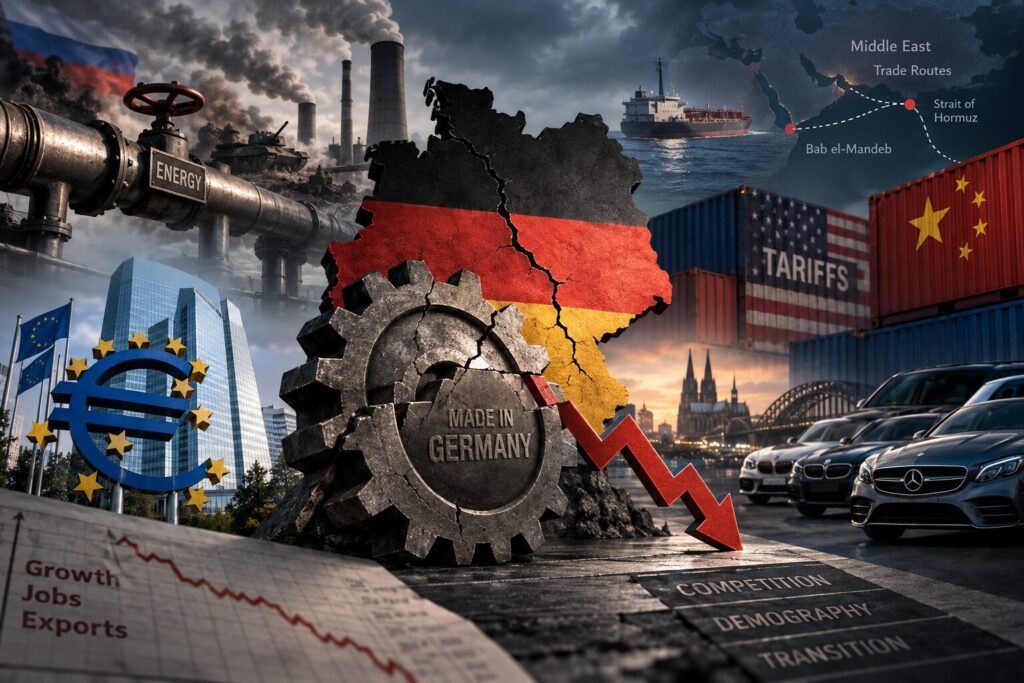
The strength of the German economy has long been associated with three interconnected elements: a massive industrial base, exceptional export capacity, and relatively stable and affordable energy supplies that enable German industry to maintain its competitiveness in global markets. However, this equation has faced an unprecedented test in recent years. The Russia–Ukraine war has transformed the structure of energy supplies in Europe and increased the cost of gas and electricity. The subsequent Iranian war and the crisis affecting maritime transport and energy supplies in the Middle East have added a new shock to oil, gas, and transportation costs, at a time when German companies are facing US tariffs and growing Chinese competition, particularly in automobiles, machinery, and industrial products. Therefore, the challenges facing the German economy cannot be reduced to a weak economic cycle; rather, they reflect the simultaneous impact of external shocks and structural imbalances within an economic model that had enjoyed considerable success for many years.
Simultaneous Shocks
Official data indicate that the German economy emerged from two consecutive years of contraction in 2025, recording growth of only 0.2%, following contractions of 0.9% in 2023 and 0.5% in 2024. This represented the longest period of consecutive annual recession in the modern history of the Federal Republic. Real industrial value added declined by 1.3% in 2025, following decreases in the previous two years, while real merchandise exports fell by 0.7%. The German Federal Statistical Office confirmed that exports faced pressure from higher US tariffs, the appreciation of the euro, and intensifying Chinese competition, while investment in equipment and construction remained weak.
The situation becomes more concerning when we move from economic output to the labor market. Germany employed an average of approximately 46 million people in 2025, but employment growth had slowed compared with the period before the financial crisis and declined slightly. Industrial employment fell by approximately 143,000 people, or 1.8%, while construction employment declined by around 23,000. Most of the increase in employment came from public services, education, and healthcare. In August 2026, the number of registered unemployed people in Germany rose to 3.061 million, while the registered unemployment rate reached 6.5%, an increase of 36,000 unemployed people compared with the same month of the previous year. Meanwhile, the number of registered vacancies at the Federal Employment Agency stood at 656,000, down by 25,000 from the previous year. These indicators reflect the gradual transmission of economic weakness from factories to the labor market.
Industrial Dilemma
The transformation is particularly evident in the automotive industry, one of the key pillars of Germany’s industrial model. The number of people employed in the German automotive industry stood at 691,500 at the end of the first half of 2026, a decline of 42,300 jobs, or 5.8%, over one year. This was the lowest level since the current statistical series began in 2005. Employment in the manufacture of vehicles and engines fell by 6.1% to 429,200, while employment in the production of parts and components declined by 7.6% to 219,500. These figures are more revealing than general statements about an automotive crisis because they show that the pressure is no longer limited to major companies but has spread significantly to the supplier network, which represents a fundamental component of Germany’s industrial strength.
The crisis in the automotive sector is not the result of a single factor. German companies are facing the costly transition to electric vehicles at a time when global competition is changing rapidly, particularly with the rise of Chinese manufacturers that have managed to combine lower costs with rapid expansion in electric and hybrid vehicle production. In 2025, German exports of vehicles and automotive components to China fell by approximately one-third to less than €14 billion, compared with nearly €30 billion in 2022. This means that the value of these exports declined by more than half in roughly three years. The Chinese market is therefore no longer simply a major destination for German automobiles; it is gradually becoming a competitive arena in which Chinese domestic manufacturers are gaining ground at the expense of European companies.
Chinese competition is not confined to China itself. Chinese manufacturers have become increasingly present in European markets, and the market share of Chinese-branded vehicles in the European Union rose to more than 9% in early 2026, according to industry data. Meanwhile, Chinese passenger-car exports exceeded 6.2 million vehicles during the first eight months of 2026, as Chinese companies expanded their presence beyond the domestic market. This development places German manufacturers in a competitive environment that differs from traditional Japanese or South Korean competition. China possesses not only growing automotive brands but also an integrated ecosystem encompassing batteries, raw materials, electronics, software, and extensive supply chains.
Mounting Pressures
The United States has added another layer of complexity. The German economy relies heavily on foreign markets, with automobiles, machinery, and industrial products accounting for a significant share of its exports. Consequently, US tariffs represent a direct burden on the competitiveness of German companies. US tariffs on European automobiles rose in 2025 from the previous level of 2.5% to 27.5%, before subsequently being reduced to 15% under the US–European trade agreement. Nevertheless, tariff costs borne by European automakers were estimated at more than €8 billion, including approximately €3.6 billion for Volkswagen, €2.1 billion for BMW, and €1.3 billion for Mercedes-Benz. These costs emerged at a time when the companies were already facing rising technological transition expenses, growing Chinese competition, and weak European demand.
However, energy remains the most fundamental factor underlying Germany’s economic crisis. German industry has historically relied on abundant energy supplies at competitive prices, particularly natural gas. The Russia–Ukraine war disrupted a substantial part of the energy model on which Germany had depended. With the loss of inexpensive Russian gas, industrial energy costs rose sharply, forcing companies to reduce production or seek more competitive production locations outside Germany. The chemical, metals, and basic materials industries remain among the sectors most exposed to these pressures. Recent data indicate that energy-intensive industries lost more than 53,000 jobs in the year through March 2026, a decline of 6.3%, suggesting that the energy crisis has evolved from a temporary cost problem into a factor reshaping Germany’s industrial landscape.
The energy shock did not end with the fading effects of the war in Ukraine. The Iranian war in 2026 added a new dimension. Tensions in the Middle East and risks to maritime navigation through the Strait of Hormuz and the Bab el-Mandeb Strait led to higher oil and gas prices and increased shipping costs. Europe consequently faced a second energy shock within a relatively short period. European studies have indicated that the wars in Ukraine and Iran generated two distinct energy shocks. Meanwhile, European gas prices in September 2026 exceeded levels anticipated under adverse scenarios previously considered by the European Central Bank, while oil prices rose above $100 per barrel. These developments have placed simultaneous pressure on industry, transportation, inflation, and household consumption.
Structural Burdens
The danger posed by these shocks lies in the fact that they affect not only companies that directly consume energy but also the entire value chain. Higher gas prices increase the cost of chemicals, fertilizers, and metals, while higher oil prices raise transportation costs. Disruptions to shipping routes increase insurance and freight expenses and extend the time required to deliver raw materials. These increases are eventually passed on to finished products. In an export-oriented economy such as Germany’s, the challenge becomes more complex because German companies cannot always pass the full increase in costs on to global consumers, particularly when Chinese competitors can offer cheaper products. This creates dual pressure on profit margins, investment, and employment.
At the same time, Germany faces a demographic challenge that is no less important than external shocks. Slower labor-force growth is occurring alongside the retirement of large numbers of older workers. The German Federal Statistical Office has identified demographic developments as a major factor behind the slowdown in the labor market, although immigration and increased participation among women and older people have helped offset part of the shortage. This means that Germany must simultaneously protect existing industrial jobs, retrain workers, and address future skills shortages—an exceptionally demanding combination that increases the cost of economic transformation.
These developments are also reflected in social conditions. Data from the German Federal Statistical Office showed that 13.3 million people, or 16.1% of the population, were at risk of poverty in 2025 under the European Union definition. Meanwhile, approximately 17.6 million people, or 21.2% of the population, were at risk of poverty or social exclusion. The rate among unemployed people was exceptionally high at 64.9%. However, it is important to avoid describing this figure as “the highest level since the Second World War,” because the EU-SILC indicator does not support such a direct historical conclusion. In particular, the current methodology in Germany dates back to 2020. It is more accurate to state that Germany is facing very high levels of poverty and social-exclusion risks, while direct comparisons with the entire postwar period remain difficult.
A Historic Transformation
Nevertheless, the German economy is not facing an inevitable collapse. The picture is more complex. Germany still possesses a massive industrial base, substantial export capacity, stable financial institutions, and globally competitive companies in automobiles, machinery, chemicals, and engineering. Public spending and investment in infrastructure and defense could provide a new stimulus to industrial demand. Some indicators also began to improve during 2026. However, the real challenge lies in transforming this cyclical improvement into structural change. The German economy needs more than demand stimulus: it must reduce energy costs, accelerate investment, modernize infrastructure, advance artificial intelligence and digitalization, rebuild competitiveness in the automotive sector, and diversify markets and supply chains.
The German crisis can therefore be understood as a historic transition rather than merely an economic recession. The model that combined inexpensive Russian energy, strong Chinese demand, global trade integration, and open markets no longer operates under the same conditions. Meanwhile, the German economy finds itself under pressure from more expensive energy, higher transportation costs, US tariffs, Chinese competition, a costly technological transition, and demographic challenges. Each of these factors can be addressed individually, but their simultaneous occurrence is what makes the current phase exceptional.
The future of the German economy will therefore depend on its ability to move from a model based on selling high-quality industrial products in a favorable global environment toward a model that is more resilient to shocks, less dependent on a single energy source or market, and more agile in innovation. If Germany succeeds in implementing this transformation, it may restore its industrial strength in a different form. However, if it treats the current shocks as a temporary crisis, today’s pressures could gradually evolve from economic stagnation into the long-term erosion of part of the industrial base that has served as one of the pillars of European economic strength for decades.