Over the past decades, analyses of the Saudi economy have been almost automatically linked to oil markets and their price cycles. Economic activity, growth rates, public spending, liquidity levels, and investment trends were largely interpreted through a single variable: global oil prices. This model had its objective justifications, as the Kingdom of Saudi Arabia possesses approximately 17% of the world’s proven oil reserves and is one of the largest producers and exporters of oil globally, making oil the primary driver of economic activity, public revenues, and exports for decades.
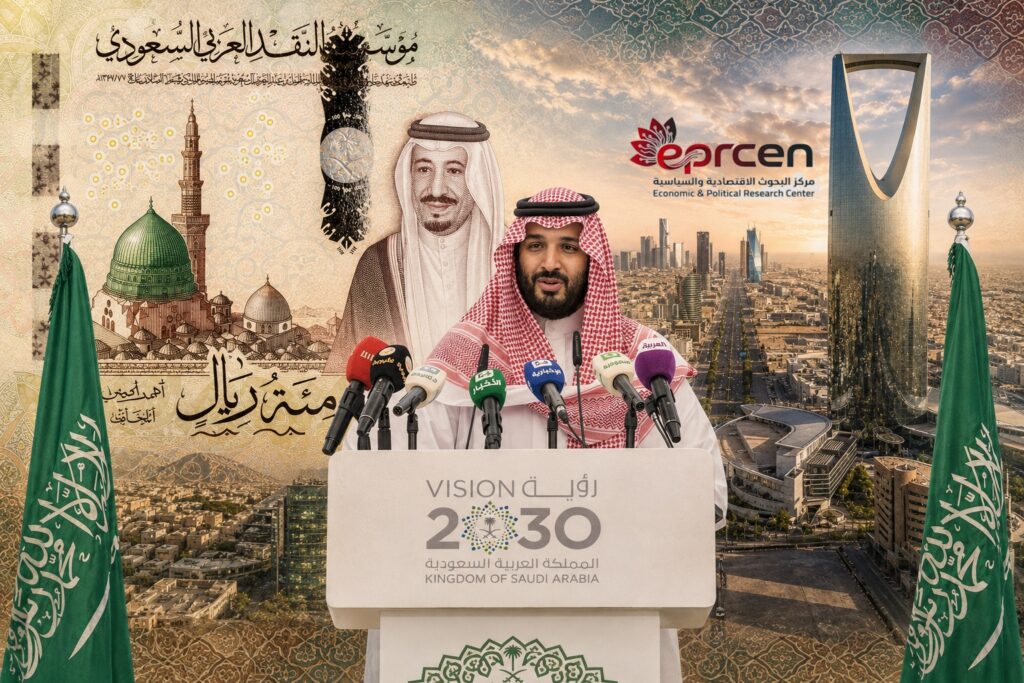
However, the past decade has witnessed an economic and structural transformation that may be considered the most profound since the establishment of the modern Saudi state. This shift is not due to a decline in the importance of oil, but rather to a change in the philosophy of economic management itself. Since the launch of Vision 2030 in 2016, the economic objective has evolved from maximizing oil revenues to building a more diversified and sustainable economic model based on productivity, investment, industry, services, technology, and the private sector as key drivers of long-term growth.
The importance of this transformation stems from the fact that economies heavily dependent on natural resources face a structural challenge known in economic literature as “resource dependency cycles,” where growth, revenues, and investment become closely tied to fluctuations in commodity prices. This often increases vulnerability to external shocks and global market volatility, prompting many resource-based economies to adopt long-term diversification strategies.
In Saudi Arabia’s case, the ongoing transformation goes beyond traditional economic diversification toward a comprehensive restructuring of the national economy, including redistributing sources of growth across sectors, redefining the roles of the state and the private sector, developing human capital, and redirecting investments toward more productive and higher value-added sectors.
From this perspective, the past decade can be viewed as a historic transitional phase that has involved not only the implementation of major economic projects but also the gradual reconstruction of the Saudi economic model, paving the way for a shift from an oil-driven economy to a multi-engine economy capable of achieving sustainable growth.
The Saudi Macroeconomy Over the Past Decade: From Traditional Oil Cycles to Reengineering Growth Drivers
During the last decade, Saudi Arabia has undergone one of the most extensive economic transformations among resource-dependent economies. It has gradually shifted from a model primarily shaped by global oil price cycles toward one that seeks to reshape growth through economic diversification, enhanced contributions from non-oil sectors, and more efficient allocation of resources and capital.
These transformations occurred amid a highly complex global environment marked by successive economic shocks, beginning with the oil price collapse of 2014–2016, followed by the COVID-19 pandemic and widespread disruptions in global supply chains, and later by global inflationary pressures, tighter monetary policies, and rising interest rates across major economies.
Despite these challenges, the Saudi economy demonstrated a remarkable capacity to absorb external shocks while maintaining relatively high levels of macroeconomic stability and resilience compared with many emerging and commodity-dependent economies.
Saudi Arabia’s GDP exceeded $1.3 trillion in 2025, compared to approximately $740 billion to $1 trillion at the launch of Vision 2030. This strengthened the Kingdom’s position as the largest Arab economy and one of the world’s top twenty economies. Real GDP growth reached approximately 4.5% in 2025, while non-oil activities grew by around 4.9%, reflecting a significant shift in the actual drivers of economic activity.
More importantly, the contribution of non-oil activities to real GDP increased to approximately 55% in 2025, up from around 45% in 2016, representing a major structural transformation in the national economy.
This shift does not imply a decline in the strategic importance of oil, which remains a key pillar of public revenues, the current account, and merchandise exports. Rather, it reflects a redefinition of oil’s role within the economy. Instead of being the direct engine of economic growth and government spending, oil is increasingly serving as a financing tool for economic transformation through investment in productive sectors with high value added.
In this context, the role of investment institutions has expanded, particularly the Public Investment Fund (PIF), whose assets under management increased to approximately $925 billion in 2025, compared to around $150–160 billion before Vision 2030, making it one of the world’s largest sovereign wealth funds.
Saudi Arabia’s labor market has also undergone significant structural changes. Women’s participation in the workforce increased from around 22% at the launch of Vision 2030 to nearly 35% by 2025, surpassing initial targets. The private sector’s contribution to economic activity has expanded steadily, driven by rapid growth in technology, manufacturing, logistics, tourism, and the digital economy.
The number of small and medium-sized enterprises reached approximately 1.7 million, supporting around 8.8 million jobs and contributing nearly 22.9% of GDP.
Non-oil exports exceeded SAR 624 billion in 2025, accounting for approximately 44% of total exports, reflecting a gradual expansion of the export base and reduced dependence on the oil sector.
Overall, the Saudi economy is no longer driven solely by traditional oil cycles. Instead, it is building a more diversified and complex set of growth engines.
Public Finance: Reshaping Revenue Structure and Fiscal Sustainability
Public finance has been one of the key pillars of Saudi Arabia’s economic reform agenda. Historically, government revenues were heavily dependent on oil prices, making fiscal performance highly vulnerable to global market fluctuations.
In recent years, the Kingdom has restructured public revenues by expanding non-oil income sources through the implementation of value-added tax (VAT), service fees, enhanced government revenues, improved spending efficiency, and greater private sector participation.
Although public debt has increased gradually, it remains relatively low compared to major economies, standing at approximately 26% of GDP.
More importantly, non-oil government revenues increased from around SAR 166 billion in 2015 to more than SAR 502 billion in 2025, representing growth of over 200% within a decade. Their share of total government revenues increased from around 10–12% before Vision 2030 to approximately 38–40% in recent years.
These developments indicate the establishment of a more stable and diversified revenue base, reducing exposure to external shocks and helping fiscal policy transition toward a more sustainable model focused on managing economic cycles rather than being driven by them.
Energy Sector: From a Source of Revenue to a Tool for Economic and Geostrategic Repositioning
The energy sector in Saudi Arabia can no longer be viewed through the traditional lens of oil as merely a source of public revenue. It has become a key instrument for economic and geopolitical repositioning at both regional and global levels.
As the world’s largest oil exporter and one of the most influential actors in global energy markets, Saudi Arabia holds approximately 17% of proven global oil reserves and produces between 9 and 12 million barrels per day, depending on market conditions.
The fundamental transformation lies in how this power is utilized. Oil is no longer regarded as an economic end in itself but rather as a strategic tool for reshaping the economy and expanding international influence.
Saudi Arabia is leveraging its position in global energy markets to build broad partnerships encompassing investment, technology transfer, manufacturing, logistics, mining, and global supply chains.
Instead of maximizing revenue from each barrel of oil sold, the Kingdom is increasingly focused on maximizing the economic, political, and investment value generated by each barrel.
Industry: From a Resource Economy to an Advanced Manufacturing Economy
The industrial sector has become a central pillar of Saudi Arabia’s economic transformation strategy.
Rather than functioning as a traditional production sector, it now serves as an integrated platform aimed at deepening industrialization, increasing value added, reducing import dependence, and enhancing economic resilience.
The Kingdom currently hosts more than 11,000 industrial facilities, driven by investments in high-value manufacturing sectors, including pharmaceuticals, defense industries, food production, advanced petrochemicals, and metal industries.
Mining has emerged as one of the most promising growth engines within the diversification strategy. Saudi Arabia’s untapped mineral resources are estimated at more than $2.5 trillion, with official targets aiming to increase the sector’s contribution to GDP to between $64 billion and $75 billion by 2030.
This transformation contributes to higher productivity, increased local content, reduced import dependency, and stronger non-oil industrial exports.
The Future of the Saudi Economy Under Vision 2030: Structural Transformation Toward a Diversified Productive Economy
Vision 2030 represents a fundamental shift from an economy primarily dependent on oil as a cyclical growth driver to a multi-engine economy built on productivity, investment, the private sector, and knowledge.
At the core of this transformation is the transition from a rent-distribution model to a sustainable value-creation model that enhances long-term economic stability and reduces vulnerability to external shocks.
The vision aims to reshape the growth function by increasing total factor productivity, which is considered the primary engine of sustainable growth.
Non-oil sectors—including industry, services, the digital economy, and renewable energy—are expected to drive the majority of future growth.
The private sector has become a cornerstone of this transformation, accounting for approximately 45% of GDP. Small and medium-sized enterprises, which represent more than 90% of companies, play a critical role in job creation and economic expansion.
The digital economy and artificial intelligence are emerging as new productivity drivers, enhancing efficiency, reducing costs, and improving resource allocation.
Human capital remains the most critical determinant of the sustainability of this transformation, given Saudi Arabia’s young population and the increasing need to align education with the requirements of the new economy, particularly in technical and knowledge-based fields.
Foreign direct investment is also evolving beyond capital inflows to become a mechanism for technology transfer, increasing local content, and integrating the Saudi economy into global value chains.
Ultimately, the trajectory of Vision 2030 reflects Saudi Arabia’s transition toward a more diversified, sophisticated, and productive economic model focused on maximizing value creation rather than relying solely on raw resources, strengthening the Kingdom’s position as a globally influential economy in the decades ahead.