

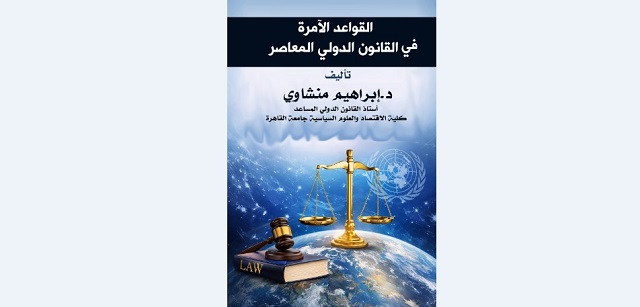
At a time when international conflicts are intensifying, interests are increasingly intertwined, and violations of international law are escalating, the book Peremptory Norms in Contemporary International Law by Ibrahim Seif Menshawy, Assistant Professor of International Law at Faculty of Economics and Political Science, Cairo University, emerges as a rigorous scholarly work that revives a fundamental question: does there still exist a legal red line that neither states nor international organizations are permitted to cross?
The book addresses this question through a thorough deconstruction of the concept of jus cogens—peremptory norms that stand above the will of states and embody the legal conscience of the international community.
The author begins with a precise examination of the concept, explaining that peremptory norms are not merely ordinary rules within international law; rather, they constitute a binding legal framework from which no derogation is permitted under any circumstances. He emphasizes that, despite its roots in Roman law and its subsequent evolution through natural law scholarship, the concept remains highly contested in terms of its definition, sources, and criteria of identification. This ongoing debate reflects both the vitality and complexity of the concept itself.
The book further reveals the profound transformation in the scope of peremptory norms. Their application is no longer confined to treaty law, as was initially the case, but has expanded into broader domains, most notably state responsibility for internationally wrongful acts, the responsibility of international organizations, and even unilateral legal acts. This expansion reflects the growing regulatory role of these norms in governing the conduct of international actors.
Within the framework of legal codification, the author devotes particular attention to the 1969 Vienna Convention on the Law of Treaties, which marked a pivotal turning point through its explicit recognition that any treaty conflicting with a peremptory norm is void. He highlights how this principle was subsequently replicated in later international instruments, reflecting an increasing international consensus regarding the centrality of the concept—particularly amid the insistence of developing countries and former socialist states on institutionalizing it as a tool for achieving a greater degree of international justice.
The analysis extends beyond treaty law to encompass the work of the International Law Commission, which played a decisive role in developing the concept, particularly through the 2001 Draft Articles on State Responsibility. Here, the book explains how the controversial notion of “international crimes” was replaced by the framework of peremptory norms following broad political and legal objections. As a result, jus cogens became the governing legal standard for addressing serious breaches of fundamental international obligations.
The author underscores the decisive legal consequences of this transformation, foremost among them: the prohibition against invoking circumstances precluding wrongfulness, the imposition of collective obligations upon states to cooperate in ending violations, the duty not to recognize unlawful situations, and the obligation not to provide aid or assistance in maintaining them.
The book deepens this discussion by examining the rules that have attained peremptory status, including the prohibitions of aggression, genocide, torture, slavery, racial discrimination, and crimes against humanity, in addition to the right of peoples to self-determination. These norms, the author argues, represent the irreducible minimum of values that the international community cannot abandon.
In a particularly notable contribution, the author demonstrates how the influence of peremptory norms has extended to international organizations through the 2011 Draft Articles on the Responsibility of International Organizations. This development reflects the comprehensive nature of these norms, which are not limited to states alone but encompass all actors within the international legal order. He further explains that such norms impose strict limitations on unilateral acts, including declarations and reservations, rendering void any act that conflicts with them.
The book also dedicates substantial attention to the growing role of international adjudication—particularly the International Court of Justice—in consolidating the doctrine of peremptory norms. From the Court’s early references to the prohibition on the use of force, to its explicit recognition of the peremptory nature of the prohibitions against genocide and torture, and finally to its affirmation of the principle of non-recognition of unlawful situations, the contribution of international jurisprudence appears central in transforming jus cogens from a theoretical construct into a binding and operational legal principle.
The author also traces the expansion of this influence into international criminal law, as well as regional and domestic courts, all of which have increasingly relied on peremptory norms in prosecuting the gravest violations. This development reflects a structural transformation in the architecture of international justice, whereby these norms have become the benchmark for assessing the legality of international conduct.
From a methodological perspective, the book is distinguished by its rigorous academic structure. It opens with an introductory chapter establishing the conceptual and theoretical foundations of the subject, before proceeding to a first section addressing legal foundations, sources, and state practice. A second section then explores issues of identification, legal effects, and normative conflicts.
Among the book’s most significant contributions is its chapter on conflicts between peremptory norms, particularly its analysis of the tension between the prohibition on the use of force and the right to self-determination in the Palestinian context. This discussion reflects a profound awareness of the complexities and contradictions embedded within contemporary international reality.
In conclusion, this substantial scholarly work offers a legal and intellectual synthesis affirming that peremptory norms are no longer merely theoretical constructs debated by jurists, but rather a governing framework embodying the legal conscience of the international community and establishing boundaries that cannot be crossed regardless of power considerations or conflicting interests.
The author clearly demonstrates that the true value of these norms lies not only in their binding nature, but also in their capacity to impose a collective legal logic capable of constraining the conduct of states and international organizations alike. They require cooperation to halt violations, reject the legitimization of unlawful situations, and prohibit complicity in maintaining them.
The book further reveals that the evolution of this concept—whether through international conventions, the work of the International Law Commission, or international judicial decisions—reflects a qualitative transformation in the structure of the international legal order itself: from a merely contractual system grounded in state consent to a more rigorous order governed by superior norms transcending unilateral wills.
Accordingly, the author places the reader before a fundamental reality: the future of international legitimacy will not be determined solely by the existence of these norms, but rather by the extent to which they are effectively implemented and respected in practice, particularly in major issues affecting human rights and international peace and security.
Thus, the book does not merely provide legal analysis and doctrinal grounding; it also implicitly advances a call to restore the authority of law in the face of hegemonic politics, emphasizing that peremptory norms remain the most effective instrument for safeguarding international justice and protecting shared human values.