
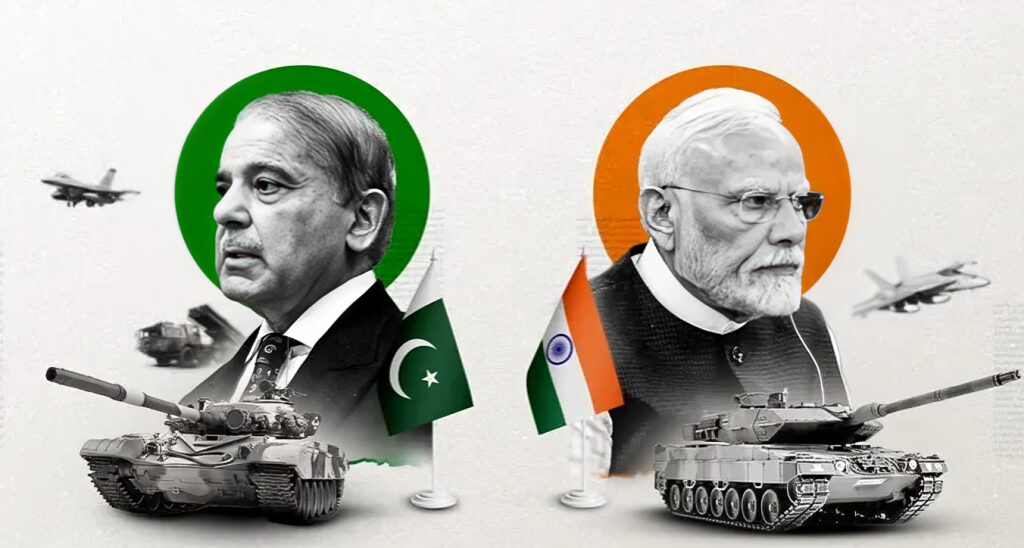
The India–Pakistan conflict is widely regarded as one of the most complex and intractable international disputes in the contemporary international system. This is not only because it has persisted since 1947, but also because it encompasses three interconnected dimensions of conflict: identity, geography, and regional status.
Over nearly eight decades, wars, agreements, and international mediation efforts have failed to eliminate the chronic tensions between the two states. Instead, they have contributed to reshaping the conflict and generating new patterns of confrontation. While Kashmir remains the geographical epicenter of the dispute, the core of the crisis extends beyond territorial boundaries to reflect a deeper competition over the nature of the nation-state, the balance of power in South Asia, and the structure of the regional order in one of the world’s most strategically sensitive regions.
The gravity of this conflict is further heightened by the fact that it involves two nuclear-armed states whose combined populations account for nearly one-quarter of the global population. Moreover, both countries lie at the center of an intensifying geopolitical competition among major powers, particularly the United States, China, and Russia.
With the outbreak of the May 2025 crisis, the conflict entered a new phase fundamentally different from previous stages. It evolved from a traditional model of nuclear deterrence to a more complex framework based on precision strikes, unmanned aerial systems, cyber warfare, and real-time escalation management, posing unprecedented challenges to security and stability in South Asia.
The Legacy of Partition
The roots of the conflict can be traced to Britain’s decision to end its colonial rule over the Indian subcontinent under the Mountbatten Plan, announced in June 1947. The plan was based on the Two-Nation Theory, which assumed that Muslims and Hindus constituted two distinct nations, each entitled to its own independent state.
Pakistan was established on August 14, 1947, while India gained independence the following day. However, the partition process was carried out hastily and without adequate institutional arrangements, resulting in one of the largest episodes of forced migration in modern history. More than 14 million people crossed the newly established borders, while between 500,000 and one million individuals lost their lives in widespread sectarian violence.
Partition also created a complex dilemma concerning the future of the princely states, which were given the option to join either India or Pakistan or negotiate their future status independently. Among these territories, Jammu and Kashmir emerged as the most contentious issue in bilateral relations.
The Kashmir Question
In 1947, Jammu and Kashmir enjoyed a special status as a princely state with a Muslim-majority population ruled by the Hindu Maharaja Hari Singh, who initially sought to preserve the region’s independence.
However, internal uprisings and the entry of tribal fighters from Pakistani territory into Kashmir in October 1947 prompted the Maharaja to seek military assistance from India in exchange for signing the Instrument of Accession to the Indian Union on October 26, 1947.
Pakistan rejected the legitimacy of this accession, arguing that the predominantly Muslim population of the region should have been granted the right to self-determination. Since then, Kashmir has remained an open flashpoint and a persistent source of tension between the two countries.
Successive Wars
India–Pakistan relations have witnessed a series of wars and military crises that have reshaped South Asia’s security landscape.
The first war broke out between 1947 and 1948 over Kashmir and concluded with United Nations Security Council Resolution 47, adopted on April 21, 1948, which called for a ceasefire and a plebiscite to determine the region’s future. This referendum has never been held.
The second war erupted in 1965 following Pakistan’s launch of Operation Gibraltar in support of insurgent activities in Kashmir and ended with the signing of the Tashkent Declaration on January 10, 1966.
The 1971 war marked a major strategic turning point, resulting in the secession of East Pakistan and the establishment of Bangladesh on December 16, 1971. This represented Pakistan’s most significant geopolitical and military setback since its creation.
In 1999, the Kargil crisis erupted when Pakistani forces infiltrated strategic positions in the Indian-administered sector of Kashmir. The crisis ended with the withdrawal of Pakistani troops under intense international pressure, marking the first direct military confrontation between two nuclear-armed states in modern history.
Governing Agreements
The Simla Agreement, signed on July 2, 1972, established the legal and political framework governing India–Pakistan relations. The agreement stipulated that disputes should be resolved through peaceful bilateral means and transformed the ceasefire line into the Line of Control (LoC).
Since then, India has adhered to the principle of bilateral resolution and rejected external mediation, viewing Kashmir either as an internal matter or as a strictly bilateral dispute.
Pakistan, by contrast, has sought to internationalize the issue and maintain it on the United Nations agenda, citing Security Council resolutions that call for a referendum on the future of the territory.
This divergence in perspectives remains one of the principal obstacles to conflict resolution, as the two countries disagree on the mechanism for settlement before addressing its substantive details.
Nuclear Deterrence
May 1998 marked a fundamental transformation in the nature of the conflict. India conducted nuclear tests in the Rajasthan desert on May 11 and 13 under Operation Pokhran-II. Pakistan responded by carrying out six nuclear tests in the Chagai region of Balochistan on May 28 and 30 of the same year.
Since then, both countries have entered a phase of mutual nuclear deterrence based on the assumption that any full-scale war would result in catastrophic losses for both sides.
However, practical experience has demonstrated that nuclear weapons have not prevented military crises. Instead, they have encouraged both sides to adopt a strategy of “limited escalation under the nuclear umbrella,” involving carefully calibrated military operations that fall short of all-out war.
This pattern was evident during the Kargil crisis in 1999, the Uri attack in 2016, the Pulwama–Balakot crisis in 2019, and the May 2025 crisis.
The Kashmir Transformation
On August 5, 2019, the Indian government revoked Articles 370 and 35A of the Constitution, thereby ending the special status that Jammu and Kashmir had enjoyed since its accession to India.
This decision marked a strategic shift in the management of the conflict, as New Delhi moved from a policy of crisis containment to one of reshaping the political and constitutional realities within the region.
India argues that fully integrating Kashmir into the federal system promotes economic development, enhances security, and curbs separatist tendencies. Pakistan, however, views the move as a violation of international law and an attempt to impose a new status quo that will be difficult to reverse, thereby widening the political divide between the two sides.
International Competition
The India–Pakistan conflict is no longer an isolated bilateral dispute. Instead, it has become embedded within a complex network of regional and international interactions.
India has emerged as a key strategic partner of the United States within the Indo-Pacific strategy aimed at balancing China’s growing influence. It has also strengthened its military and technological cooperation with members of the Quadrilateral Security Dialogue (Quad), including the United States, Japan, and Australia.
Pakistan, on the other hand, maintains close strategic relations with China, which is the country’s largest foreign investor through the China–Pakistan Economic Corridor (CPEC), one of the flagship projects of the Belt and Road Initiative.
In this context, Kashmir has acquired additional significance beyond its historical dimension because of its sensitive geographical location at the intersection of Indian, Pakistani, and Chinese strategic interests.
A Critical Turning Point
The events of May 2025 represented a significant turning point in the trajectory of the conflict.
On April 22, 2025, an armed attack in Pahalgam, located in Indian-administered Kashmir, resulted in the deaths of 26 civilians. New Delhi accused Pakistan-linked groups of orchestrating the attack, while Islamabad denied any involvement.
On May 7, 2025, India launched a military operation known as Operation Sindoor, targeting what it described as militant infrastructure inside Pakistani territory. Pakistan responded by launching Operation Bunyan al-Marsous, leading to the most intense direct military confrontation between the two countries since the 1999 Kargil crisis.
The crisis revealed a qualitative transformation in the nature of military engagements, characterized by the extensive use of drones, precision-guided missiles, and advanced air defense systems, before a ceasefire was reached on May 10, 2025, through intensive diplomatic efforts.
New Strategic Equations
The 2025 crisis demonstrated that the traditional rules of engagement between India and Pakistan are undergoing a fundamental transformation.
Previously, concerns associated with nuclear deterrence imposed strict limitations on direct military operations. Today, however, both sides appear increasingly willing to conduct limited and carefully calculated strikes based on the assumption that the other party will avoid large-scale escalation.
At the same time, the proliferation of drones, satellite surveillance systems, and artificial intelligence technologies has reduced the time available for military decision-making, increasing the risk of miscalculation and unintended escalation.
Cyber warfare, disinformation campaigns, and intelligence operations have also emerged as central instruments of conflict management alongside conventional military capabilities.
A Strategic Dilemma
India and Pakistan face a complex strategic dilemma that significantly limits the prospects for a comprehensive settlement.
India seeks to consolidate its position as a rising global power, a goal that requires a stable regional environment enabling it to focus on its economic and technological priorities. Simultaneously, however, it has adopted increasingly stringent security policies toward Pakistan.
Pakistan, for its part, considers preserving the centrality of the Kashmir issue a strategic and existential necessity to prevent a further imbalance in the regional power equation.
Under these circumstances, any political concession by either side carries substantial domestic costs, as it is perceived as a threat to national security and national identity. This dynamic helps explain the persistence of political deadlock despite the severity of the shared risks.
Future Outlook
As of June 2026, current indicators suggest that the India–Pakistan conflict has entered a phase of “armed peace.” This condition does not imply the absence of confrontation; rather, it reflects a fragile equilibrium based on nuclear deterrence and advanced military capabilities.
The coming period is likely to witness the continuation of short, intense crises instead of prolonged conventional wars, alongside the growing importance of non-traditional instruments of conflict, particularly cyberattacks, drones, and intelligence operations.
Kashmir is expected to remain the primary flashpoint in the absence of any meaningful political horizon for settlement and amid continuing U.S.–China competition for influence in South Asia.
Consequently, the greatest risk does not lie in the deliberate outbreak of a full-scale war but rather in the possibility of miscalculation or unintended escalation, especially given the shrinking timeframe for military decision-making and the increasing reliance on advanced technologies.
The future of stability in South Asia will therefore depend on the ability of India and Pakistan to develop sustainable crisis management mechanisms, strengthen military and political communication channels, and reduce the risks of nuclear escalation to prevent any limited border incident from evolving into a broader regional crisis.