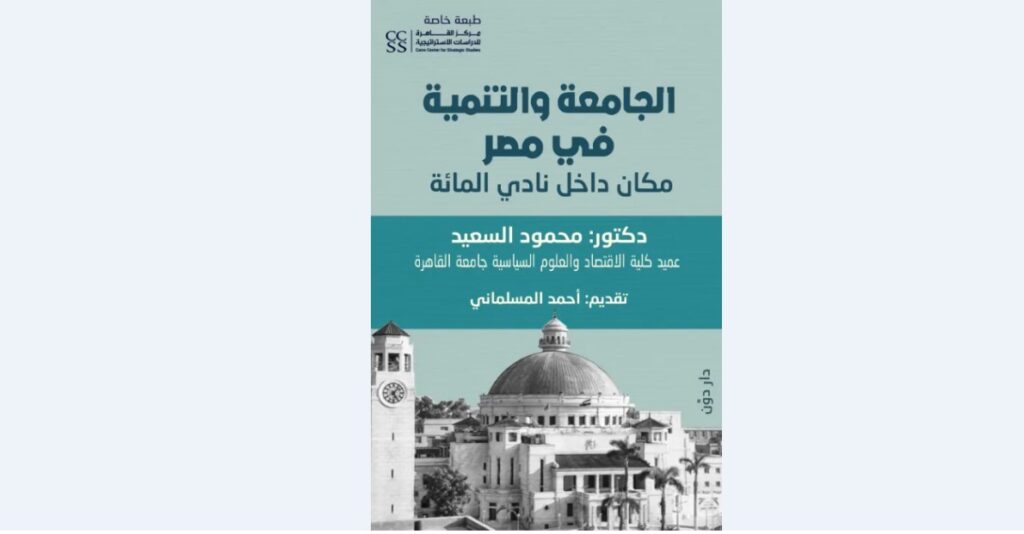
At a moment when the Egyptian state is rearranging its developmental priorities, the book The University and Development in Egypt: A Place in the Top 100 Club by Dr. Mahmoud El-Said, Vice President of Cairo University for Graduate Studies and Research, emerges as an important intellectual contribution that restores due recognition to the university as one of the pillars of building the modern state, rather than merely an educational institution that grants degrees. The book proceeds from a clear conviction that scientific research and higher education are no longer an intellectual luxury, but have become an essential condition for renaissance, a tool of comprehensive power, and a key entry point for achieving sustainable development and Egypt Vision 2030.
The title of the book carries an ambitious significance. The “Top 100 Club” refers to the legitimate aspiration for Egyptian universities to enter the ranks of the world’s top 100 universities in international rankings. This is a position the author believes Egypt deserves, given its scientific history and educational leadership within its Arab, African, and Middle Eastern surroundings. From this perspective, the book does not treat university ranking as a mere formal number or a matter of institutional prestige, but rather as a reflection of the state’s ability to produce knowledge, develop scientific research, connect the university with the labor market, and build generations capable of competing locally, regionally, and internationally.
The book consists of twenty-seven articles divided into two main chapters. The first chapter addresses issues related to education and scientific research in Egypt, while the second turns to a number of questions concerning sustainable development, the nation, and the citizen. In the first chapter, the author presents a broad vision of the status of Egyptian education in comparison with educational systems around the world. He discusses the international indicators used to measure the quality of education and examines the position of Egyptian scientific journals in global databases such as Scopus and Clarivate. He emphasizes that developing local journals and enhancing their competitiveness in publishing international research represent an important step toward improving the global image of Egyptian scientific research.
The book does not merely present challenges; it also confronts some of the rumors that have accompanied discussions about education in Egypt in recent years, foremost among them the claim that Egypt has been excluded from international education rankings. The author shows how inaccurate or selectively presented information can be used to harm the image of the state and its institutions, calling for international indicators to be read in a precise and scientific manner, away from both exaggeration and underestimation. The book also opens the door to the idea of making use of international experts and professors in Egyptian universities, whether in teaching, training, or academic supervision, by benefiting from digital communication tools that have made international academic cooperation easier and less costly.
One of the notable issues discussed in the book is the dispatch of master’s and doctoral students abroad. The author does not reject scholarships in principle; rather, he stresses their importance in transferring expertise and knowledge from prestigious international universities. However, he raises a fundamental question about the usefulness of public expenditure on scholarship students who do not return to serve their homeland after completing their studies. From this standpoint, he calls for stricter regulations to ensure that the state and society benefit from this investment, or for encouraging researchers to obtain external funding from foreign universities, thereby reducing the burden on state resources and achieving a balance between the researcher’s freedom and the national interest.
The book also links education to the National Dialogue, considering President Abdel Fattah El-Sisi’s call for national dialogue to be an important shift in Egyptian political life that can positively affect education and scientific research. In the author’s view, education reform cannot be separated from building a strong and modern economy capable of localizing industry, enhancing production, and creating competitive sectors. In the same context, the book discusses the relationship between academic specialization and the labor market, pointing out that the world no longer gives priority to specialization alone, but rather to competence, skills, training, and the ability to develop continuously.
The author clearly criticizes the excessive reliance on university notes and summaries, considering that this phenomenon not only harms the quality of education, but also creates an informal market that drains families financially and weakens the value of genuine knowledge. Through this issue, the book broadens its view of education as “the issue of all issues,” because weak education is reflected in most of society’s problems, from poverty and disease to extremism and corruption. What is required, therefore, is not merely an increase in the number of degree holders, but the creation of a social context that values science and research and sees them as a path toward solving society’s problems and shaping the future.
In the second chapter, the book moves to development issues in Egypt, addressing highly significant topics such as population growth, limited water resources, the economic cost of violence against women, the quality of statistical data, and the use of figures in psychological warfare against states. Here, the author’s awareness becomes evident: development is not merely a set of economic projects, but an integrated system that requires accurate data, strong institutions, an aware society, and the ability to confront distortion campaigns that use fabricated or misleading statistics to create anxiety and undermine public confidence.
Overall, the book concludes that Egypt, despite the internal and external challenges it has faced, has managed to continue its path toward development with the least possible losses and to achieve progress in the areas of security, stability, urban development, and preparing an investment-friendly climate. Thus, The University and Development in Egypt: A Place in the Top 100 Club does not merely offer an academic reading of education; it presents a conscious defense of the idea of a state that bets on people, knowledge, and scientific research, and that realizes that entry into the future begins with the university. Egypt’s natural place among nations is not made by history alone, but by its continuous ability to learn, innovate, and compete.