
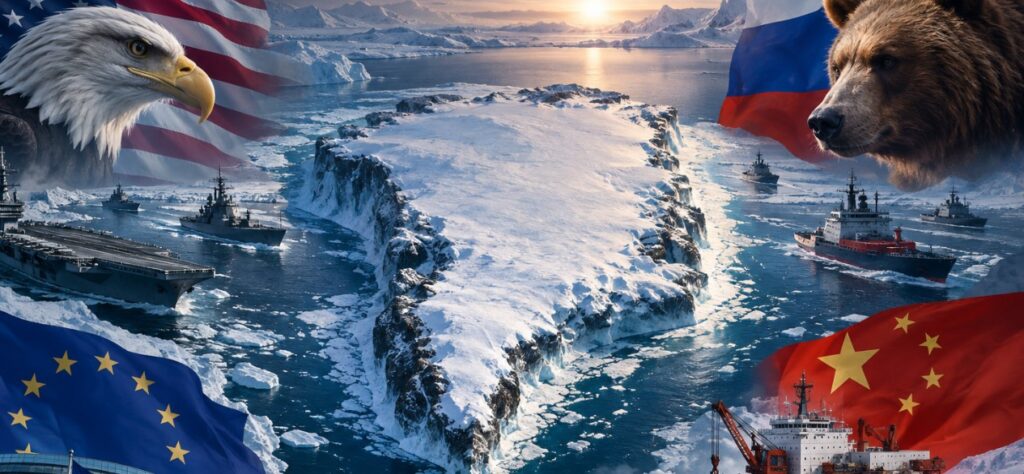
Greenland is no longer a remote, ice-covered island at the northernmost reaches of the world. In recent years, it has become a point of convergence for US national security interests, European ambitions in the Arctic, Chinese interests in critical minerals, and Russia’s expanding military presence. At the heart of this competition lies a vast geographical territory inhabited by approximately 57,000 people and spanning more than 2.16 million square kilometers, with ice covering nearly 80% of its land area, according to United Nations data and Greenlandic statistics. This geographical paradox helps explain why the island remains economically limited at present, while its strategic value far exceeds the size of its economy.
Greenland’s importance stems from its location between North America and Europe, its proximity to evolving Arctic maritime routes, and its position within the strategic sphere of early-warning networks and the monitoring of air and maritime activity across the North Atlantic. Its geographical position also gives the power that exercises substantial influence over the island greater capacity to monitor the maritime gap stretching between Greenland, Iceland, and the United Kingdom. This area is of critical importance in calculations involving submarine movements and strategic deterrence between Russia and NATO.
American Security Interests
Washington views Greenland through a lens that extends beyond natural resources. The central issue concerns the island’s position along potential approaches to North America and its ability to support space-based surveillance systems, missile-warning networks, and the monitoring of Russian military activity in the Arctic Ocean. The island hosts the US Pituffik Space Base, which performs functions related to early warning, satellite tracking, and space operations.
Existing defense agreements between the United States and Denmark have allowed Washington to maintain a military presence in Greenland for decades. This means that the island’s military value does not necessarily require a transfer of sovereignty to the United States. A substantial portion of US security objectives can be achieved by expanding military infrastructure, strengthening surveillance systems, upgrading airports and ports, and intensifying cooperation with Denmark and Greenland’s self-governing authorities.
From this perspective, US President Donald Trump’s insistence on revisiting the Greenland issue can be understood as an attempt to secure broader strategic guarantees, rather than simply seeking to acquire additional territory. Recent developments have pointed toward an arrangement that would strengthen the American military presence while keeping Greenland under Danish sovereignty, alongside conditions aimed at preventing strategic rivals, particularly Russia and China, from establishing a military presence on the island. However, such an arrangement would not become final until the necessary political and legal procedures in Denmark and Greenland have been completed.
Deferred Wealth
Greenland possesses mineral resources that help explain a significant part of the international competition surrounding the island. These include potential deposits of rare earth elements, nickel, cobalt, lithium, graphite, uranium, and other minerals used in the production of batteries, electric motors, wind turbines, military equipment, and advanced electronics. However, converting these resources into tangible economic value faces major obstacles related to the harsh climate, the distance between mining sites and ports, high transportation and energy costs, inadequate infrastructure, and a limited pool of specialized labor.
The US Geological Survey estimates Greenland’s rare earth element resources at approximately 1.5 million metric tons. This quantity gives the island potential importance in diversifying global supply sources, but it does not mean that commercially viable reserves are ready for extraction. The distinction between geological resources and economically recoverable reserves is critically important, particularly in a region that requires substantial investment in roads, ports, energy infrastructure, and processing facilities. Moreover, extracting rare earth minerals would not, in itself, resolve dependence on China unless independent capabilities for separation, refining, and intermediate manufacturing were also established.
This point becomes increasingly significant in light of China’s dominance over key stages of rare earth supply chains. Possessing raw materials underground is not sufficient to alter the balance of power. The greatest strategic value lies in the ability to transform those resources into high-purity industrial materials, magnets, and components used in advanced industries. This is why the United States and Europe are seeking access to Greenland’s resources as part of a broader strategy to reduce the risks associated with the concentration of global mineral processing in China.
The European Presence
Europe regards Greenland as part of the strategic sphere of the Kingdom of Denmark. At the same time, it recognizes that the Arctic has become a direct theater of European security, particularly following the war in Ukraine and the accession of Finland and Sweden to NATO, which expanded the geographical scope of defense coordination in Northern Europe.
Although Greenland is not a member of the European Union, it was part of the European Community until 1985 and continues to benefit from institutional and financial ties through the Kingdom of Denmark. Brussels also views the island as an opportunity to develop partnerships in renewable energy, satellite communications, critical minerals, scientific research, and Arctic infrastructure.
The European Commission has announced an investment package worth €200 million to strengthen cooperation with Greenland and Denmark, focusing on critical minerals, space communications, and renewable energy. This signals that Europe’s response to American pressure extends beyond political statements and is moving toward an expanded economic and institutional presence on the island, while emphasizing that Greenland’s future must be determined by its people.
However, Europe’s ability to act remains constrained by the limitations of its Arctic infrastructure, the need for long-term financing, and the delicate balance between environmental protection and the promotion of mining activities. It must also coordinate with the United States within NATO. Consequently, Europe’s objective is not to turn Greenland into a sphere of influence competing with Washington, but rather to prevent the strategic decisions surrounding the island from being monopolized by a single power.
China’s Calculations
China views the Arctic as an increasingly important arena for scientific research, maritime routes, and access to natural resources. In its official documents, it has described itself as a “near-Arctic state,” despite not being an Arctic state. This designation reflects Beijing’s desire to gain political and economic legitimacy to participate in the region’s emerging arrangements.
China’s primary instruments include investment, scientific cooperation, the development of icebreaker capabilities, and participation in mineral supply chains. However, attempts by Chinese companies to expand their presence in Greenland have faced reservations from Danish and Greenlandic authorities due to security concerns, particularly when projects have involved airports, ports, or mineral deposits of strategic importance.
China’s true strength lies in its industrial processing capabilities, rather than necessarily in direct control over territory. Beijing may be able to benefit from Greenland’s resources through long-term purchase agreements, industrial partnerships, or processing arrangements outside the island. Therefore, preventing Chinese investment in mines alone would not settle the question of Chinese influence unless it were accompanied by a comprehensive Western strategy to develop alternative refining and manufacturing capabilities.
Russian Pressure
Russia views the Arctic as a central security and economic domain. It possesses the world’s longest Arctic coastline and has spent years investing in military bases, ports, icebreakers, and infrastructure associated with the Northern Sea Route, which could become increasingly important as sea ice recedes and navigational seasons change.
Moscow does not exercise direct influence over Greenland, but it benefits from the island’s position in the military calculations of the North Atlantic. Its location between North America and Europe makes Greenland part of the region’s deterrence and surveillance equation. Meanwhile, growing Russian-Chinese cooperation in the Arctic has raised concerns in the West that economic collaboration could evolve into long-term strategic influence.
Nevertheless, Russia and China should not be portrayed as possessing an immediate ability to control Greenland. The geographical, political, and security obstacles are substantial. The island is part of the Kingdom of Denmark, and the surrounding security architecture is closely linked to NATO, making any attempt by Russia or China to establish a military presence there highly costly and risky.
The Economics of Sovereignty
Greenland presents a profound economic dilemma. It possesses vast territory, potentially significant mineral wealth, and a rare strategic location, yet it remains heavily dependent on fishing, fish processing, and financial support from Denmark. According to Statistics Greenland, GDP amounted to approximately DKK 22.9 billion in 2023, while the value of goods and services exports reached roughly DKK 9.35 billion. The fishing industry remains the primary source of external revenues, reflecting the gap between substantial geological potential and a limited productive base.
Consequently, Greenland’s future will depend not only on which party seeks to exercise political influence over the island, but also on its ability to transform international interest into responsible investment that enhances productivity, creates jobs, develops infrastructure, protects the environment, and ensures that local residents receive a meaningful share of the economic returns.
Ultimately, the competition over Greenland is not merely about an ice-covered island. It concerns the future of the Arctic itself: who will have the capacity to monitor its routes, secure its resources, control its infrastructure, and shape its economic and security frameworks. The United States seeks to safeguard its strategic defensive depth, Europe aims to consolidate its presence in its broader strategic geographical sphere, China is looking for a foothold in Arctic supply chains, while Russia is working to protect its military and economic interests in the north.
The most sensitive aspect of this equation, however, is that Greenland is not a commodity to be traded among the great powers. Its future is tied to the rights of its people and the sovereignty arrangements of the Kingdom of Denmark. Any economic or security project that fails to take this reality into account will remain vulnerable to setbacks, regardless of the scale of the anticipated resources or the surrounding geopolitical interests. Ultimately, Greenland’s true strength will not be measured solely by whose flag flies over the island, but by who can build a long-term partnership that makes its people key stakeholders in their own economic and strategic future.