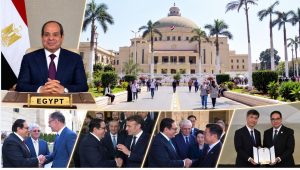
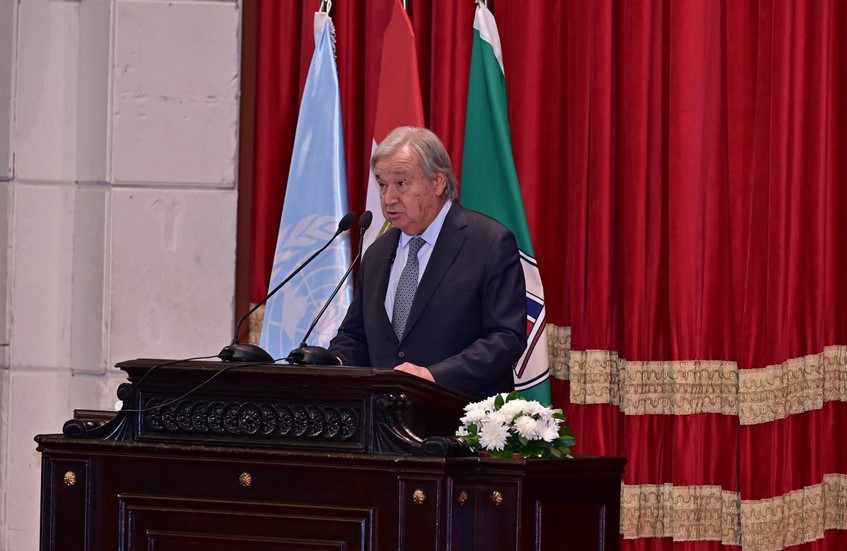
The speech delivered by António Guterres, Secretary-General of the United Nations, beneath the dome of Cairo University was far more than a ceremonial address at an international event. It conveyed political, humanitarian, and civilizational messages that transcended the boundaries of the venue, raising fundamental questions about the future of the international order, the ability of diplomacy to contain conflicts, and the responsibility of younger generations to build a more just and secure world. These questions are particularly pressing at a time when wars are intensifying and confidence in the ability of international institutions to uphold international law is waning.
The visit acquired particular significance as it marked Guterres’s return to Cairo University, which he visited in February 2017, shortly after assuming the position of Secretary-General. His return in October 2026, toward the conclusion of his tenure at the helm of the United Nations, provided a meaningful point of comparison. In the intervening years, the global landscape had undergone profound changes, marked by wars, humanitarian crises, economic disruptions, climate-related challenges, public health emergencies, and the rapid transformations brought about by artificial intelligence. These developments made the messages conveyed in his speech more closely connected to the realities experienced by societies and more relevant to young people who will bear the consequences of these transformations.
Civilization and Openness
Guterres’s praise for Cairo University and Egyptian civilization carried significance beyond diplomatic courtesy. By invoking Egypt’s historical role in shaping human knowledge, he underscored the principle that civilizations flourish not through isolation, but through openness, the exchange of knowledge and expertise, and interaction among peoples and cultures. This message is particularly important because it offers an alternative to trends that seek to erect barriers between countries or treat civilizational differences as sources of conflict rather than opportunities for complementarity and cooperation.
Human history has not advanced through civilizations that remained closed to the outside world. Rather, progress has emerged from the transmission of scientific knowledge, the exchange of ideas and experiences, and interaction among societies in the fields of knowledge, trade, the arts, and philosophy.
From this perspective, the reference to Egypt as a cradle of civilization and a bridge connecting Africa, the Arab world, and the Mediterranean region reflects its geographical and historical position as a meeting point for multiple civilizational spheres. This position is not merely a legacy of the past; it also places a responsibility on Egyptian institutions, particularly universities, to sustain this role by generating knowledge, engaging with international experiences, and preparing generations capable of dialogue and interaction with the wider world.
A nation’s civilizational capacity is measured not only by its archaeological treasures and historical heritage, but also by its ability to transform that heritage into a contemporary source of strength in education, scientific research, innovation, and human development.
The International Order
The UN Secretary-General’s address came at a time when the international order is facing a serious test of the credibility of the principles upon which it was established after the Second World War. These principles include respect for state sovereignty, the peaceful settlement of disputes, the protection of civilians, and adherence to international law.
Guterres’s remarks on wars, humanitarian crises, and the risks associated with the declining respect for international law highlighted the gap between declared principles and actual practices. The problem lies not merely in the outbreak of conflicts, but also in the difficulty of preventing their escalation, protecting civilians, ensuring the delivery of humanitarian assistance, and translating international decisions and positions into tangible outcomes on the ground.
The significance of this message lies in the fact that crises are no longer confined to their geographical boundaries. A war in one region may affect energy and food prices, transportation and insurance costs, trade and investment flows, refugee movements, and the stability of economies far removed from the conflict itself. Peace, therefore, is no longer simply a moral or political concern detached from economic development. It has become a fundamental prerequisite for market stability, improved living standards, and the protection of opportunities for future generations.
Nevertheless, the importance of the Secretary-General’s address should not be measured solely by the force of its rhetoric, but also by the ability of the United Nations and its member states to translate the principles it reaffirmed into effective mechanisms for mediation, ceasefires, civilian protection, accountability for violations, and the provision of funding for humanitarian responses.
This brings into focus one of the central dilemmas confronting the United Nations: how can an international order based on shared rules be preserved amid conflicting interests among major powers and disparities in their ability to influence international decision-making?
This question makes the call for multilateralism and international cooperation a practical necessity rather than merely a diplomatic slogan.
Youth and the Future
The messages addressed to students and young people constituted one of the most significant dimensions of the meeting. Universities are not merely institutions for acquiring knowledge or obtaining academic qualifications; they are spaces for developing awareness, cultivating critical thinking, and preparing future leaders capable of addressing the complex challenges facing the world.
This role has become increasingly important amid transformations in labor markets and rapid advances in artificial intelligence, which are creating new opportunities while also raising concerns about the digital divide, the distribution of technological gains, the future of employment, and the potential widening of inequalities among countries and societies.
Accordingly, the message addressed to Cairo University students extended beyond an appeal for academic excellence. It was a call to acquire the tools of knowledge, develop proficiency in foreign languages, understand international relations, engage thoughtfully with technology, and participate in scientific research and community initiatives, while recognizing that global issues are no longer distant matters detached from everyday life.
Students of economics, for example, need to understand the relationship between conflicts and food and energy prices, debt, and investment. Students of political science must appreciate the complexities of negotiations, power balances, and the limitations of international institutions. Researchers in technology, meanwhile, must consider the ethical and social implications of artificial intelligence applications.
In this way, the university becomes a meeting point between theoretical knowledge and real-world challenges, as well as between individual aspirations and public responsibility.
The true value of such encounters lies in transforming temporary interest in a particular event into research questions, student initiatives, scientific partnerships, and training programs that open broader horizons for young people to participate in shaping the future.
Egypt’s Role
Egypt’s role in supporting mediation and the peaceful settlement of disputes received clear attention in Guterres’s address. He highlighted Egypt’s importance in bringing perspectives closer together, convening different parties, and creating opportunities for dialogue at a time when international divisions are deepening.
The significance of this role stems from Egypt’s regional position, its Arab, African, and international ties, and its capacity to engage with multiple parties. These advantages are reinforced by Egypt’s founding membership in the United Nations and its participation in peacekeeping and humanitarian efforts.
These attributes provide Cairo with considerable scope to engage in issues requiring sustained political communication, regional and international coordination, and continuous efforts to bridge differences. With regard to the Palestinian question, Guterres emphasized the importance of reaching a just settlement, underscoring the need to respect the legitimate rights of the Palestinian people, foremost among them the right to self-determination. He also stressed the importance of the two-state solution, ensuring the delivery of humanitarian assistance to the Gaza Strip, protecting civilians, and working toward an end to the conflict.
In this context, the importance of Egypt’s diplomatic efforts lies in their combination of political engagement, initiatives aimed at containing escalation, humanitarian assistance, and efforts to establish a sustainable political process. Addressing regional crises requires more than managing their immediate consequences. It also demands confronting their underlying political and humanitarian causes, preventing their expansion, and creating the conditions necessary for a just settlement with genuine prospects for durability.
These efforts are closely connected to other regional crises, particularly the situation in Sudan, where security, humanitarian, and development considerations intersect. This makes cooperation among states and international organizations essential to addressing the consequences of conflict, alleviating civilian suffering, and supporting prospects for stability.
From this perspective, Egyptian diplomacy should not be viewed merely as an instrument of foreign engagement, but also as a means of protecting national interests, contributing to regional stability, and reducing risks whose consequences may extend to the economy, society, and national security.
Egyptian Diplomacy
The participation of the Egyptian Ministry of Foreign Affairs in the meeting reaffirmed that Egypt’s relationship with the United Nations extends beyond official visits and ceremonial occasions. It encompasses political, humanitarian, and development issues that require continuous coordination between national institutions, the United Nations, and its specialized agencies.
The statement delivered on behalf of Foreign Minister Badr Abdelatty reflected Egypt’s appreciation of its longstanding relationship with the United Nations and reaffirmed its commitment to respect for state sovereignty, the peaceful settlement of disputes, adherence to international law, and support for multilateral cooperation.
The importance of these principles extends beyond their theoretical dimension. Effective diplomacy requires building consensus, identifying shared interests, managing disagreements, and making use of international institutions to address issues that individual states cannot efficiently resolve on their own. It also requires maintaining channels of communication, even during periods of acute tension, because the breakdown of dialogue narrows the prospects for settlement and increases the costs of conflict for all parties.
From this standpoint, coordination among the Ministry of Foreign Affairs, national institutions, universities, and international organizations creates broader opportunities for exchanging expertise, building institutional capacity, supporting scientific research, and developing programs related to sustainable development and youth empowerment.
The central challenge facing multilateral diplomacy remains the transition from agreement on principles to their consistent implementation. The protection of civilians, respect for international law, and the provision of humanitarian assistance must not become hostage to shifting political considerations.
The effectiveness of the international order depends on its ability to apply rules consistently to all parties, strengthen confidence in institutions, and deliver tangible outcomes for the populations that bear the greatest costs of conflict.
Cairo University
Cairo University’s hosting of the UN Secretary-General reflects recognition of its academic and historical standing and underscores its role in building bridges between scientific institutions and international bodies concerned with peace and development. The meeting embodies the continuation of cooperation between the university, the United Nations, and its specialized agencies. It also highlights the university’s scientific, research, and community contributions to advancing the Sustainable Development Goals, fostering a culture of peace, and promoting the values of citizenship, tolerance, and diversity.
In this context, Professor Mohamed Sami Abdel Sadek, President of Cairo University, deserves recognition for his efforts to strengthen the university’s international presence and expand its engagement with global expertise and experiences. Such efforts enhance the university’s capacity to fulfill its academic and societal mission.
Hosting António Guterres gives students an opportunity to engage directly with issues occupying the international community and deepens their understanding of challenges associated with politics, economics, and international law.
The meeting also reflects the importance of an administrative vision that connects the academic institution’s historical legacy with contemporary demands and seeks to transform its academic standing into tangible opportunities for dialogue, knowledge exchange, and international partnership.
In this sense, the significance of the meeting extends beyond its diplomatic symbolism. It reaffirms that the university is an active partner in shaping public awareness and preparing generations capable of understanding global transformations and contributing to efforts to address their challenges.