
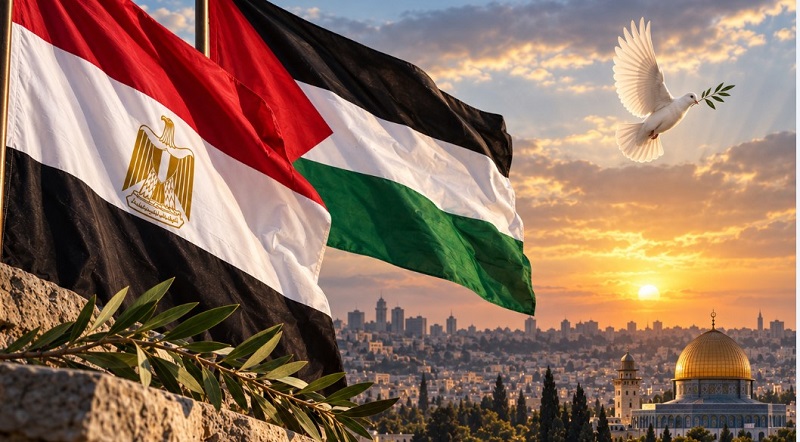
The Palestinian cause has constituted the core of Egypt’s national security and a steadfast pillar in the formulation of its foreign policy. Egyptian diplomacy has not merely adopted the Palestinian position in regional and international forums; it has also leveraged Egypt’s geopolitical weight and international relations to provide the cause with sustained momentum, securing it a permanent place on the global agenda.
Given that the Palestinian cause represents a fundamental component of Egypt’s political principles and strategic orientations, a central question arises regarding the mechanisms and instruments employed by Cairo to restore the Palestinian cause to the forefront of the international agenda, particularly after it had been neglected for many years as a result of rapidly changing regional and international dynamics and shifts in the balance of power in favor of the Israeli occupation, at the expense of Palestinian rights.
The Egyptian military’s defense of the Palestinian cause and Egypt’s diplomatic support for it represent a logical extension of the cause’s centrality in Egyptian military doctrine and in the country’s popular and political consciousness. The Egyptian armed forces have fought multiple wars in defense of Palestinian rights, and the blood of Egyptian martyrs was shed on Palestinian soil. Their graves remain living testimonies that the Palestinian cause has never been a temporary issue in Egyptian diplomacy, but rather a deeply rooted pillar of the collective consciousness of both Egypt’s leadership and its people.
Over the decades, Egyptian foreign policy has consistently expressed its support for the Palestinian people’s legitimate struggle to achieve freedom and independence, establish an independent state on their national territory, and secure their right to self-determination. Egypt has also firmly rejected any attempt to undermine Palestinian national rights. This resolute position was most clearly demonstrated during the genocidal war waged against the Gaza Strip, when Cairo firmly opposed Israeli occupation plans aimed at forcibly displacing the population of Gaza toward Sinai, declaring such displacement a red line and a direct threat to Egyptian national security.
Accordingly, Egyptian foreign policy has established several pillars for preserving the Palestinian cause and restoring its prominence on the international agenda through the following key areas:
Multilateral Political and Diplomatic Engagement
Cairo has consistently worked to advance the legitimate national rights of the Palestinian people across international forums and platforms, particularly through the United Nations General Assembly and the UN Security Council. It has also placed the Palestinian cause at the forefront of bilateral and multilateral summits bringing together the Egyptian leadership and world leaders.
This approach has been particularly evident in strategic discussions with influential international powers, including recent joint presidential meetings with the Chinese leadership, which emphasized the imperative of ending the occupation and establishing a Palestinian state in accordance with international legitimacy resolutions.
Egypt’s diplomatic engagement has also been clearly reflected in its addresses to major international groupings, such as the BRICS Summit, where Egyptian statements have focused on the urgent need to end the humanitarian suffering and alleviate the injustice endured by the Palestinian people. Egypt has emphasized that overcoming the crisis requires concerted international and diplomatic efforts to safeguard the Palestinian people’s continued presence on their historic land and enable them to exercise their legitimate rights in accordance with United Nations resolutions.
Egypt’s role has not been limited to raising the Palestinian cause in international forums. Cairo has also supported Palestinian political and diplomatic efforts to secure international recognition of Palestinian rights. Egypt has utilized its diplomatic influence and network of strategic relations to encourage numerous countries around the world to recognize the State of Palestine. These efforts have contributed to the gradual increase in the number of countries recognizing Palestine, which has approached 160, while also supporting the elevation of its diplomatic representation in international forums.
Furthermore, Egypt’s active diplomacy has played a pivotal role in addressing international public opinion and challenging what Cairo considers to be misleading Israeli narratives that have constrained Arab and Palestinian diplomatic efforts for decades. Through its diplomatic engagement, Egypt has sought to expose the practices of the occupation and challenge its repeated attempts to portray itself as the victim at the expense of the legitimate rights of the Palestinian people.
Legal Action and Documentation of Occupation Crimes
Cairo has played a significant role in international legal efforts to expose alleged acts of genocide and grave violations of international humanitarian and human rights law committed by the Israeli occupation in the Gaza Strip. The legal pleadings and memoranda submitted by Egypt before the International Court of Justice and its engagement with the International Criminal Court have represented important developments in the legal and human rights context surrounding efforts to hold the occupation accountable for alleged war crimes committed against the Palestinian people.
In addition, Egypt has provided substantial support to Palestinian legal and human rights institutions, drawing on its accumulated expertise and institutional human and logistical resources. This support has helped Palestinian actors document Israeli crimes and violations in a professional manner capable of withstanding scrutiny before international judicial and human rights bodies.
Such efforts have contributed to strengthening international public awareness of the Palestinian cause and highlighting the legal challenges posed by the practices of the occupation, which has repeatedly been accused of violating international law, international humanitarian law, the Geneva Conventions, and other international legal instruments.
Multilateral Mediation and Support for Palestinian Resilience
Since the first day of the war in Gaza, Egypt has undertaken sustained efforts to secure a ceasefire in the Strip. This was not the first time Cairo had succeeded in negotiating and sponsoring de-escalation agreements in Gaza. However, the exceptional nature of this war required different mechanisms and instruments for dealing with an increasingly hard-line Israeli government accused of committing crimes against humanity and of openly expressing intentions to forcibly displace the Palestinian population.
Egypt responded decisively by declaring that any such displacement plan would constitute a direct threat to its national security and a red line that Cairo would not tolerate. Egypt has made clear that it would not allow the forced displacement of Palestinians toward Sinai.
To achieve this objective, Egypt worked in close coordination with various regional and international parties to halt the bloodshed and systematic killing. Cairo also played a central role in encouraging the administration of US President Donald Trump to exert serious pressure on the Israeli government in order to reach a ceasefire agreement, which was signed in Sharm El-Sheikh on October 11 in the presence of prominent international representatives, giving the agreement significant political momentum.
Despite the fragility of the agreement and continued Israeli attempts to undermine it, Egyptian diplomacy has continued its mediation efforts to consolidate a comprehensive ceasefire and ensure the implementation of its provisions, thereby countering plans pursued by elements of the Israeli right to expel Palestinians from their lands.
Egypt’s efforts have not been confined to the diplomatic and political spheres. The humanitarian assistance provided by Cairo has represented a vital lifeline in supporting the survival and resilience of the Palestinian people in Gaza. The Strip has endured a war characterized by widespread destruction, severe humanitarian deprivation, and systematic restrictions on access to essential necessities, amid the devastation of its infrastructure.
The Egyptian people and the Egyptian state have shouldered a substantial burden in securing and delivering humanitarian assistance in its various forms, despite persistent Israeli obstacles and attempts to impose a new reality through military escalation and security arrangements concerning the Rafah crossing.
In this context, Egypt has repeatedly affirmed its sovereignty and stressed that the Rafah crossing is a border crossing between Egypt and Palestine and that Israel has no sovereignty over it under any circumstances.
Promoting Palestinian Dialogue and Reconciliation
Cairo has continued its intensive efforts to host Palestinian factions with the aim of ending internal divisions. Multiple rounds of dialogue have been held, resulting in understandings and agreements that have consistently sought to restore Palestinian national unity.
The Egyptian leadership recognizes that achieving Palestinian unity is a fundamental factor and an urgent necessity for strengthening the Palestinian cause’s presence on the international agenda. Unity helps close gaps that could otherwise be exploited by projects hostile to Palestinian rights.
Against the backdrop of the repercussions of the war in Gaza, alleged practices of ethnic cleansing in the West Bank, and intensified efforts by the Israeli right-wing government to eliminate the Palestinian presence, dismantle Palestinian political identity, and annex Palestinian territories in an attempt to reshape the region’s geography and demographics in accordance with visions of “Greater Israel,” Cairo has undertaken extensive efforts to consolidate Palestinian ranks and unify political positions.
These efforts have been pursued through continuous coordination between the Egyptian and Palestinian leaderships, alongside close cooperation with Arab partners and allies.
Within this intensive diplomatic context, Cairo hosts high-level summits bringing together the Egyptian leadership with Palestinian and Arab counterparts. These meetings include discussions among Egyptian President Abdel Fattah El-Sisi, Palestinian President Mahmoud Abbas, and Saudi Crown Prince Mohammed bin Salman on common issues, as well as the repercussions of the region’s ongoing crises and wars on the stability, security, and peace of its peoples and on their shared destiny.
Conclusion
Egyptian foreign policy continues to pursue political, diplomatic, legal, and humanitarian initiatives at various levels to ensure that the Palestinian cause and the Palestinian people’s right to self-determination remain at the forefront of the international agenda.
Despite the crowded international landscape, marked by multiple areas of conflict and attempts by certain actors to marginalize global attention to the Palestinian cause, Egypt’s commitment to maintaining an active Palestinian presence at both the regional and international levels has remained a consistent priority.
This commitment continues until the Palestinian people achieve freedom and independence and establish their own independent state, with East Jerusalem as its capital, in fulfillment of a long history of shared struggle and as a means of safeguarding the national and strategic security of both Egypt and Palestine.