

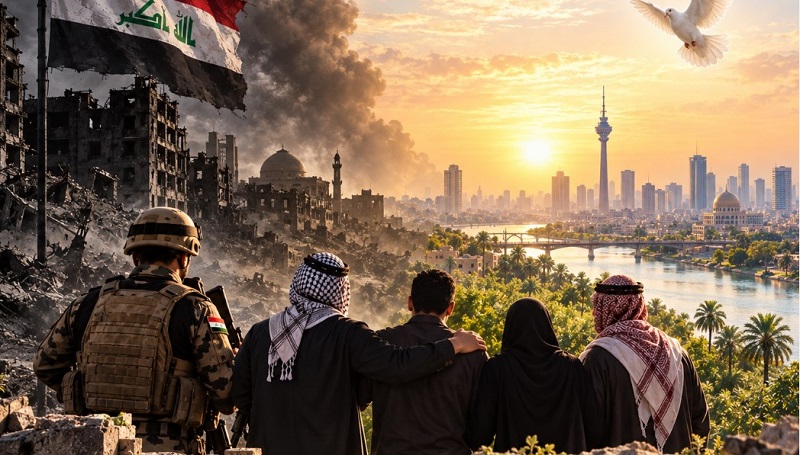
There is no doubt that the means of achieving security are diverse, and that the nature of security itself varies. There is temporary, emergency security, as well as permanent, sustainable security. Both are important; however, the former should be part of the immediate plan of any security institution, but it should not represent the ultimate aspiration. Rather, the ambition of security institutions and their leaders should be to achieve the second type of security: sustainable security.
Sustainable security can establish stability at all levels and, consequently, make a substantial contribution to eradicating the roots of terrorism and restricting its activities within society. Under temporary security conditions, terrorist organizations exploit every vulnerability and capitalize on every space occupied by groups opposing the ruling authority. Sustainable security, by contrast, seeks not only to combat terrorism militarily but also to address its underlying causes and prevent its recurrence.
The relationship between terrorism under temporary and sustainable security conditions can be compared to the difference between effective treatment and temporary painkillers: the former achieves lasting recovery, whereas the latter provides only temporary relief.
The significant efforts made by Iraq to combat terrorism and achieve security and peace at the domestic level cannot be denied, particularly given the implications of these efforts for regional and international security. Within a relatively short period, compared with initial expectations, Iraq succeeded in confronting terrorist organizations with considerable force and liberating the territories they had occupied in approximately three years. This constitutes a significant achievement for the Iraqi government and people and represents a distinctive experience worthy of examination and academic study.
Nevertheless, the security achieved following the military victories appears to be predominantly temporary rather than sustainable. By sustainability, we mean the establishment of genuine and lasting security and stability. The latter represents a critical pillar of counterterrorism efforts. Terrorism and terrorist organizations tend to operate and flourish under temporary security conditions, whereas sustainable security constrains their activities, facilitates their identification, and may ultimately lead to their elimination if firmly established across all Iraqi provinces. Accordingly, there is a substantial distinction between fighting terrorism, defeating terrorist organizations, and pursuing comprehensive counterterrorism.
One of the most important factors behind Iraq’s success in confronting terrorism has been the awareness among Iraqis of the threat these organizations pose to the country’s present and future, as well as the exposure of their schemes and the misuse of religious discourse to justify terrorist activities. This has been complemented by the substantial efforts of the Iraqi security forces across all branches, which have achieved significant progress on multiple fronts.
Iraq has confronted terrorism since 2003, engaging along what has become one of the world’s longest-running counterterrorism fronts. The country has also emerged as a significant focal point for terrorist organizations. Nevertheless, the ultimate objective should not be limited to military confrontation. What is required is comprehensive counterterrorism. The key issue that must be emphasized is the substantial distinction between fighting terrorism and countering terrorism, as each requires different conditions and methods of response. Clearly defining the objective is therefore essential to identifying the appropriate measures.
The preceding discussion has provided a very brief overview of the lessons learned from Iraq’s experience. The focus must now shift to the challenges of sustainability, as sustainability represents the ultimate goal. The principal indicators of sustainable security and comprehensive counterterrorism in Iraq can be identified as follows.
National Unity as a Pillar of Sustainable Counterterrorism
One of the most important factors contributing to the weakening of terrorist organizations is the achievement of national unity. Research and academic studies consistently indicate that the presence and growth of such organizations are closely associated with social and political divisions. Conflicts and disputes create fertile ground for the emergence of terrorist organizations. Consequently, achieving national unity and promoting societal reconciliation constitute a significant challenge to terrorism.
The question, therefore, is how national unity can be achieved. Regardless of its specific components, the concept of national unity refers to the process of bringing the members of a given society together within the framework of a single state and a political system founded on peaceful coexistence. It also involves fostering dialogue and mutual understanding, thereby strengthening the bonds of cohesion and unity and creating a socially, politically, economically, and culturally integrated society.
Given Iraq’s diverse social fabric and the security, political, social, and economic circumstances it has experienced, particularly since 2003, it is evident that Iraq has an urgent and pressing need for national unity and peaceful coexistence. This is essential if the country’s territorial integrity and the safety of its citizens are to be preserved.
The real danger lies in allowing these fundamental principles to remain mere slogans raised during elections or periods of security instability and subsequently forgotten. National unity is a crucial foundation for establishing sustainable security and strengthening counterterrorism efforts.
Political Moderation as a Pillar of Sustainable Counterterrorism
The absence of political moderation has a clear impact on the political process in any country, particularly in societies characterized by religious, ethnic, and sectarian diversity. Political moderation can significantly contribute to reducing divisions and bringing divergent perspectives closer together. It can also facilitate compromise solutions that allow conflicting parties to move toward common ground.
Moderation is not exclusive to a particular social group; rather, it exists across all segments of human society and manifests itself in various forms and contexts.
Political moderation, in this context, does not mean abandoning principles of justice or compromising the truth merely to satisfy an opposing party. Instead, it refers to adopting balanced positions between conflicting and opposing perspectives, avoiding rigid and non-negotiable options, and refraining from privileging the interests of one party at the expense of another.
In other words, moderation entails selecting the most feasible and practical solutions from the available alternatives while taking into account the prevailing differences and orientations concerning a particular issue. It also requires avoiding unilateral measures that may be interpreted as attempts to marginalize one party in favor of another.
Constructive Intellectual Dialogue as a Pillar of Sustainable Counterterrorism
The intensity of disagreements and conflicts among political partners, as well as their repercussions for the broader political and security processes, cannot be overlooked. Such disputes cannot be resolved without dialogue. However, this should not be dialogue based on courtesy or superficial accommodation, nor should it be confrontational dialogue driven by dispute and antagonism. Rather, it should be integrative dialogue, whose objective is not to scrutinize or undermine the other party but to understand and accommodate differing perspectives.
Constructive intellectual dialogue, which we seek to establish as a foundation for sustainable security, can be defined as the peaceful and calm exchange of opinions and ideas. It requires broad-mindedness, tolerance, and an awareness that human beings are fallible and not immune to error. Consequently, human ideas and decisions are inherently relative and subject to revision.
The fundamental purpose of dialogue is not merely to bring different viewpoints closer together but also to pursue objective, evidence-based, and scientifically sound outcomes.
Conclusion
The preceding analysis demonstrates that responsibility for counterterrorism does not rest solely with security agencies; it also lies with political authorities. The principal instruments for achieving sustainable security are, to a significant extent, within the domain of political leadership.
Regardless of how advanced military capabilities become or how extensively intelligence efforts are strengthened, additional measures remain necessary. These measures do not fall exclusively within the responsibilities of security institutions but also concern political and legislative bodies.
Sustainable security requires a comprehensive set of coordinated measures. Reliance solely on military, security, and intelligence efforts, without complementary political action, may achieve a certain degree of security, but it is unlikely to produce sustainable security. Security measures must therefore be integrated with political measures to eradicate the roots of terrorism and establish the conditions necessary for comprehensive counterterrorism.
The following key conclusions highlight the role of political authorities in counterterrorism:
1. Achieving political consensus: Efforts should be made to promote political consensus among competing political forces and to unify their efforts. This is not impossible as long as there is genuine and serious commitment among all parties. A unified program supported by the majority of political blocs should be developed. All political forces must therefore activate constructive intellectual dialogue to strengthen cohesion, as unity contributes to restricting terrorism and reducing the space in which it operates.
2. Ensuring the independence of security institutions: Political parties and partisan organizations should be prevented from controlling certain components of security institutions. The independence of security and military institutions must be upheld. This is not merely a political aspiration but also a requirement for implementing the provisions of the applicable Iraqi Constitution.
3. Addressing the shortcomings of national reconciliation initiatives: The reasons behind the failure of previous reconciliation conferences should be examined, and a genuine national reconciliation project should be developed rather than a merely protocol-driven initiative. Such a project must be founded on essential principles, particularly the Constitution and the law. All contentious issues should be addressed within the framework of constitutional and legal provisions to resolve them through consensual mechanisms under the rule of law and the Constitution.
4. Strengthening the relationship between security institutions and political authorities: The relationship between security institutions and political authorities is interdependent. Neither can function effectively without the other. The more effectively political institutions perform their duties, the easier it becomes for security and military institutions to fulfill their responsibilities.