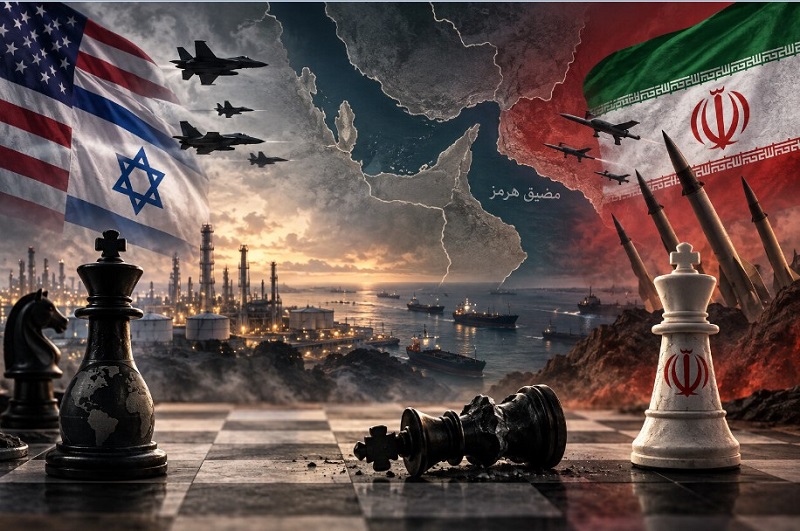
More than six months after the outbreak of the U.S.–Israeli war against Iran on February 28, 2026, it is no longer possible to assess the confrontation solely on the basis of the scale of Iranian military losses or the extent of damage inflicted on its nuclear and missile programs. The prolonged nature of the war and the widening scope of its repercussions have shifted the focus of debate toward the future of the Iranian regime, its ability to preserve internal cohesion, and the limits of the United States and Israel’s ability to translate military superiority into a political outcome.
At the same time, developments during the war have demonstrated that Iran, despite the strikes and pressures it has endured, remains capable of employing its instruments to raise the costs of confrontation and extend its repercussions beyond its borders through its missile and drone capabilities, its influence over maritime and energy security, and, moreover, its network of affiliated armed groups at the regional level. Consequently, the war is no longer merely a bilateral confrontation; it has become a factor influencing the security and economic calculations of the Gulf states and global trade and energy flows.
In parallel, broader signs of transformation have begun to emerge in the strategic environment of the Middle East. The Gulf states are reconsidering the concept of deterrence and the nature of their security arrangements, while Turkey and Pakistan are assuming more prominent roles. Meanwhile, Russia and China are seeking to protect their interests and relations with Tehran without becoming directly involved militarily in any confrontation. Accordingly, the most important outcome of the war may not be measured solely by the fate of the Iranian regime, but rather by the impact the war will have on the regional order and the network of balances that has governed the region over recent years.
First: Has the Survival of the Iranian Regime Become Threatened?
Since the beginning of the war, Iran has faced one of the most severe tests since the establishment of the Islamic Republic in 1979. The U.S.–Israeli strikes have not been limited to military and nuclear facilities; they have also extended to senior levels of the leadership structure. The killing of Supreme Leader Ali Khamenei at the beginning of the war represented a major turning point, followed by the selection of Mojtaba Khamenei as the new Supreme Leader by the Assembly of Experts on March 8. This transfer of power took place under exceptional circumstances and consequently raised renewed questions about the role of the Islamic Revolutionary Guard Corps (IRGC) in maintaining the regime’s cohesion and determining the distribution of power within it. In other words, questions have emerged regarding the nature of decision-making and the extent to which the balance of power within the Iranian regime has changed.
Nevertheless, the following months demonstrated that weakening the regime does not necessarily mean its collapse. Despite the loss of prominent political and military figures and the continued pressure on infrastructure and military capabilities, state institutions have maintained a degree of continuity, while the IRGC has continued to play a central role in managing Iran’s domestic affairs at both the military and security levels. Therefore, the most significant transformation may not be the sudden collapse of the regime, but rather the manner in which power is redistributed within it. The continuation of the war and the security and military priorities it imposes have strengthened the position of the IRGC and security agencies at the expense of some traditional political and religious institutions. We have observed growing assertiveness by the IRGC and an incomplete alignment with the political leadership, as the continuation of the war has pushed the Guard toward adopting a more security- and military-oriented approach to governing the country, both domestically and externally.
Nor can this trajectory be separated from the economic situation. Sanctions, restrictions on trade and oil exports resulting from the U.S. blockade of Iranian ports, in addition to disruptions to maritime navigation, are eroding the Iranian economy’s ability to adapt. The use of the Strait of Hormuz as a pressure instrument also carries a dual cost: while it increases the costs imposed on adversaries and global energy markets, it simultaneously constrains Tehran’s ability to conduct trade and generate revenues. Thus, the greatest threat to the Iranian regime may emerge from the interaction between military attrition, economic pressures, and the erosion of political legitimacy, particularly if these factors are accompanied by divisions within the political elite or widespread social unrest within Iranian society.
Second: A War That Can Be Prolonged… but Is Difficult to Resolve
The war has demonstrated a clear gap between achieving military superiority and translating that superiority into a decisive political outcome. The United States and Israel possess greater capabilities to target Iranian facilities and weaken Tehran’s military and economic capabilities. At the same time, however, Tehran retains instruments that enable it to increase the costs of the war for its adversaries and the global economy simultaneously, foremost among them the Strait of Hormuz, as well as missiles, drones, and affiliated armed groups across the region.
The danger of this factor became particularly evident with developments in September, when maritime traffic declined and attacks on ships and energy infrastructure intensified, coinciding with oil prices rising above $100 per barrel. A strategic Saudi pipeline was also attacked, with the East–West oil pipeline in the Riyadh and Medina regions reportedly targeted by drones launched from Iraq. This demonstrated the war’s capacity to transfer part of its costs to neighboring states and to global energy and trade networks.
Washington and Tel Aviv possess the capacity to continue exerting pressure and undermining Iran’s capabilities. However, achieving the objective of regime change or compelling Tehran to accept complete political submission would require broader military intervention, carrying substantial costs and risks. Conversely, Tehran possesses tools capable of disrupting maritime navigation and energy supplies, but it does not have unlimited economic capacity to sustain an open-ended war of attrition. Accordingly, the outcome of the confrontation cannot be measured solely by the size of the lethal military arsenal; rather, it must also be measured by the ability to withstand the passage of time and its consequences.
Third: Are Negotiations Still Possible?
Despite the expansion of the military confrontation, the diplomatic track remains central. Indeed, the enormous cost of the war may transform negotiations into an urgent and unavoidable necessity. Nevertheless, reproducing the traditional formula of nuclear negotiations is no longer sufficient, as the current crisis has moved beyond the nuclear issue to encompass more complex regional and security dimensions.
Within this complex landscape, Omani mediation has emerged as a vital channel. Oman launched a dedicated track concerning the future of navigation through the Strait of Hormuz in June 2026, followed by momentum in political and technical negotiations during July and August. Although the parties reached an understanding on August 25 to discuss a phased framework guaranteeing a temporary maritime corridor and a project to clear the Strait of mines, the difficulty of fully reopening the waterway demonstrates that developing technical arrangements is considerably easier than reaching a comprehensive political and security settlement.
Accordingly, the prospect of a “grand bargain” appears remote compared with a phased negotiating process that begins with de-escalation and securing energy routes, followed by a reduction in military operations, and eventually moves toward the most complex issues. Such fragmented understandings could prevent the slide toward a full-scale war without making a comprehensive settlement of all disputes a prerequisite for progress.
Fourth: Reshaping the Map of Regional Alliances and Balances
Perhaps the most enduring consequence of the 2026 war lies in the tangible and fundamental transformation of the region’s security doctrines and the repositioning of its alliances. The regional landscape is no longer governed by the traditional sharp polarization between a U.S.–Israeli axis confronting Iran, which is politically supported by Russia and China. Instead, it has opened the way for the emergence of a more flexible network of alliances through which regional powers seek to balance their historical partnerships with greater strategic autonomy, while simultaneously strengthening their own defensive capabilities.
In this context, the Mecca Mutual Defense Agreement between Saudi Arabia, Turkey, and Pakistan in August 2026 stands out. The agreement stipulates that an armed attack against any one of the three countries shall be considered an attack against all three. This does not necessarily signify the emergence of a “Middle Eastern NATO,” but it does reflect a trend toward more structured defense and security coordination. The extent to which this relationship develops will depend on the nature of the actual commitments among the three states and their ability to reconcile their differing regional interests.
On the other hand, the war has exposed the limits of Iran’s partnership with Russia and China. Moscow and Beijing do not wish to see Iran weakened in a manner that alters the balance of power in favor of the United States and its allies. However, these interests have not translated into a willingness to enter into direct military confrontation in defense of Tehran. This highlights the distinction between a strategic partnership and a defense alliance and may prompt Iran to reassess the extent to which it can rely on major powers during periods of direct threat.
At the same time, Iran’s network of influence in Iraq, Lebanon, and Yemen is facing mounting pressure, without being completely stripped of its instruments of influence. Tehran-aligned factions continue to possess the ability to expand the scope of the conflict, particularly in Iraq and Yemen and along international maritime routes. Nevertheless, the military and economic blockade imposed on Tehran is increasingly reducing the financial and logistical resources available to support these actors. This is occurring alongside growing concerns and sensitivities among the governments concerned regarding the consequences of turning their territories into arenas for settling scores and extending the repercussions of the war.
Fifth: The Post-War Period… Three Possible Scenarios
Scenario One: A Limited and Gradual Settlement
Given the continuation of mediation channels and the rising economic and security costs of the confrontation, a limited and gradual settlement appears to be one of the more plausible paths in the near term. It could begin with a halt to major military operations, the securing of maritime routes, and de-escalation, followed by the opening of separate negotiating tracks addressing the more complex issues.
This approach would provide an exit that does not require either side to declare defeat. However, it would remain fragile unless mechanisms were established to prevent a rapid return to escalation.
Scenario Two: A Prolonged War of Attrition
The confrontation could continue at a low to medium level of intensity, punctuated by waves of escalation and reciprocal strikes. In this scenario, the United States and Israel could continue to pressure Iranian capabilities, while Iran would employ asymmetric tools to increase the costs imposed on its adversaries.
The danger lies in the transformation of the war into a quasi-permanent state of instability, with recurring repercussions for maritime navigation, energy markets, and investment, as well as an increasing security burden on the Gulf states.
Scenario Three: The Crisis Moves Inside the Regime
The simultaneous deterioration of the economy, the severe consequences of the war, divisions within the ruling elite, or the outbreak of widespread popular protests could shift the center of the crisis from the external frontlines to the core of the regime’s internal structure.
However, such a transformation would not necessarily entail Tehran’s immediate collapse. Governing institutions might resort to a strategy of absolute centralization, while the institutional center of gravity would shift decisively in favor of the IRGC and the security establishment.
This could produce a more radicalized and militarized form of governance, less reliant on traditional sources of legitimacy. As a result, the strategic debate would shift from the question of whether the regime will survive to the question of what the new regime itself would look like and how it would be structured.
Conclusion: What Kind of Iran Will Emerge from the War?
After more than six months of confrontation, military and economic pressure has not resulted in the collapse of the Iranian regime, nor has Tehran succeeded in forcing a strategic retreat by the United States and Israel. Between these two extremes, a more complex equation is taking shape:
Iran is weaker than it was before the war, but it has not been defeated; its adversaries possess clear military superiority, but they have not yet translated that superiority into a decisive political outcome.
If the confrontation ends in a settlement, Iran will face the necessity of restructuring its priorities amid the erosion of some of its capabilities and the rising cost of restoring its regional influence through its previous methods. If the war continues, the shift of power toward the IRGC and security institutions may accelerate. If the war is accompanied by a broad internal economic and political crisis, a deeper process of restructuring power may begin, the consequences of which will be difficult to predict.
At the same time, the effects of the war will not be confined to Iran. The crisis has prompted the Gulf states to reassess their concepts of security and deterrence, reaffirmed the importance of maritime routes and logistical alternatives, and highlighted the growing roles of Turkey and Pakistan. It has also exposed the limits of the support that Russia and China can provide to Tehran in a direct military confrontation.
The war has further demonstrated that the security of the Gulf, energy, and global trade are interconnected issues, and that any disruption in the Strait of Hormuz or the Bab el-Mandeb Strait is rapidly transmitted to energy prices, insurance costs, shipping, and supply chains.
Accordingly, the most important strategic outcome of the war may not be the fall or survival of the Iranian regime, but rather the nature of the Iran that emerges from the conflict and the shape of the regional security order that develops around it.
The question, therefore, is not simply whether Iran will survive, but what kind of Iran will survive—and in what kind of Middle East?