The university in the contemporary international system is no longer merely an institution that awards academic degrees. It has become one of the actors shaping countries’ image and their ability to build long-term influence. In this context, Cairo University stands out as an important Egyptian model of the transformation of higher education from a traditional academic function into an instrument of international presence and soft diplomacy. Recent developments in the number of international students, the expansion of international partnerships, the growing scope of research cooperation, and the improvement of the university’s position in internationalization indicators and global rankings reveal a qualitative transformation in the university’s ability to attract the world to Cairo, rather than merely sending its graduates abroad.
Internationalization and Global Reach: Key Figures
According to the latest announced data, the number of international students at Cairo University increased from 24,474 in the 2023/2024 academic year to 33,872 in 2025/2026, representing an increase of approximately 38.4% over two years. More significantly, the number of international postgraduate students increased from 3,150 to 5,671, an increase of nearly 80%, while the number of undergraduate and bachelor’s students rose from 21,324 to 28,201. These figures reflect more than merely numerical growth in enrollment; they reveal an expansion in the university’s ability to reach different international education markets and growing demand for its academic programs, particularly at the postgraduate and research levels.
Cairo University has more than 33,000 international students from over 110 countries, giving it a broad international composition within the campus itself. This point is particularly significant because geographical diversity does not simply mean the presence of multiple nationalities; it represents a cross-border human network interacting on a daily basis within the educational institution. An African student meets an Asian, Arab, or European student, experiencing an academic and cultural environment in Cairo before returning home with an educational and social experience of Egypt. In this way, the university indirectly becomes a space for communication and interaction among societies and countries.
Academic Reputation and International Competitiveness
Cairo University’s ability to attract such a large number of international students cannot be understood separately from its accumulated academic reputation. International students, particularly at the postgraduate level, do not choose a university based solely on geographical location. They look for degree recognition, research reputation, the availability of specialized programs, opportunities for academic networking, and the strength of the faculty. Accordingly, improvements in the university’s international indicators become an important factor supporting its attractiveness, as academic reputation functions as an intangible asset whose value accumulates over time.
Cairo University ranked 182nd globally in the Times Higher Education ranking of the world’s most international universities for 2026, compared with 187th in 2025. According to the published data, it was the only Egyptian university included in the ranking. This indicator is particularly important because it measures the international dimension of the university rather than its overall academic performance alone. Therefore, Cairo University’s advancement in this indicator represents evidence of its growing international presence, while scientifically distinguishing leadership in a specific indicator from the claim that it is the world’s leading university across all fields.
The expansion of internationalization coincides with improved performance in other rankings, as Cairo University has advanced in several international indicators in recent years. This strengthens its visibility among international students, researchers, and potential partners. Rankings should not be viewed as an end in themselves, but rather as external indicators that influence the decisions of students, researchers, and institutional partners and contribute to shaping the university’s international reputation.
Research as a Driver of Internationalization
Internationalization gains greater value when it is linked to scientific research. Published data indicate that Cairo University recorded more than 7,500 internationally published scientific papers in 2025 according to the Scopus database, while the share of international collaboration in these publications reached approximately 48.1%. Here, an important relationship emerges between international students and scientific research: an international postgraduate student is not merely a source of tuition revenue, but may become a research partner, a member of an academic network, and a bridge connecting Cairo University with scientific institutions in the student’s home country.
The broader objective is not simply to attract large numbers of students, but to attract academic and research talent. An outstanding postgraduate student may become a research collaborator, then a partner in a scientific project, and potentially a professor at a foreign university who maintains ties with Cairo University. Thus, the policy of attracting international students becomes part of a strategy for attracting talent and building scientific networks, rather than merely an admissions and enrollment policy.
International Partnerships and Their Activation
Over the past two years, the administration of Cairo University has held meetings with more than 180 international universities, participated in more than 600 international conferences, forums, and workshops, and concluded approximately 80 agreements under the Erasmus framework, in addition to 34 international partnerships. These figures indicate that the university’s internationalization strategy has not relied solely on attracting students, but has moved toward building a broader institutional international network. A university with an extensive international network can continuously generate new channels for attracting students, researchers, faculty members, and projects.
More important than the number of agreements is the extent to which they are activated. The university has announced that it has 41 active international agreements, including 35 agreements activated over the past two years, in addition to cooperation with around 80 universities in France, Serbia, Germany, and European Union countries, as well as five international bachelor’s programs and nine postgraduate programs. Here, partnership moves from paper to practice. An agreement that produces a joint program, student exchange, or research project has greater strategic value than an agreement that remains within the framework of a formal protocol.
Another strength is that Cairo University’s network is not concentrated in a single geographical region. During its participation in the 2026 European Association for International Education (EAIE) Conference and Exhibition in Glasgow, the university held meetings with institutions from the United States, the United Kingdom, Germany, France, the Netherlands, Canada, Malaysia, Belgium, and other countries to discuss joint and dual-degree programs, academic exchange, and research projects. This diversity provides the university with a broader network of relationships, reduces dependence on a single educational market, and enables the exchange of expertise among different academic models.
Erasmus agreements represent one of the important tools in this process because they connect the Egyptian university with a broad network of European universities and create opportunities for academic mobility, exchange, and research cooperation. The significance lies in the fact that a student who comes to Cairo University or participates in a program connected to an international network does not perceive the institution merely as a local university, but as part of a broader academic network. This enhances the international value of the degree and the educational experience acquired by the student.
Cairo University in the International Education Market
Competition for international students has become increasingly evident in the region. In Saudi Arabia, King Saud University reports having international students from dozens of nationalities, while Gulf universities such as Qatar University rely on scholarships, international services, and exchange programs to attract students from abroad. These models reflect the transformation of Arab higher education into a field of international competition rather than merely a local educational service.
Cairo University, however, possesses an additional element: the combination of academic history, cultural significance, Cairo’s geographical position, and accumulated experience in Arab and African education. This provides it with important assets in attracting students seeking an educational experience that extends beyond the boundaries of university study.
The 2026 Times Higher Education list of the world’s most international universities demonstrates that global competition for students and researchers now includes universities from Asia, Europe, and the Middle East, including Gulf, Turkish, and Asian universities occupying advanced positions. Cairo University ranked 182nd globally in the internationalization indicator. This means that competition is no longer limited to traditional universities in the United States and Europe; Asian, Arab, and Middle Eastern universities are increasingly competing for the international education and research market.
The Economic Dimension and the Knowledge Economy
Cairo’s location represents an element of attractiveness that cannot be separated from the university’s performance. An international student coming to Cairo does not receive a university experience isolated from the surrounding environment. Rather, the student studies in a city with major historical, cultural, and political significance. Cairo provides an opportunity to engage with Egyptian civilization, Arab and African institutions, the Arabic language, regional markets, and the political and cultural landscape of the region. In this sense, geographical location becomes an educational and cultural asset that adds to academic value.
The value of international students extends beyond direct university tuition. International students require accommodation, transportation, food, communications, activities, and services, generating expenditure beyond the university campus. From a political-economy perspective, attracting international students can be viewed as part of the knowledge economy, in which the university becomes a point of attraction for human capital and knowledge itself becomes a resource subject to international exchange. At the same time, the local economy benefits from related activities involving students, their families, visitors, researchers, and conferences.
The international student becomes even more valuable after graduation. A graduate who has spent several years in Egypt maintains relationships with professors and colleagues and may work in governmental, private, or research institutions in their home country. Over time, these relationships can develop into professional networks that benefit Egypt in trade, investment, scientific research, tourism, and cultural cooperation. This reveals one of the most important dimensions of educational diplomacy: the real return may not materialize during the period in which tuition fees are paid, but years later after the student graduates and enters the labor market and national institutions of their home country.
Human Capital and Alumni Networks
By virtue of its long history, Cairo University possesses a broad base of alumni in Egypt, the region, and around the world. This represents a highly important institutional asset because an alumni network can become a permanent channel of international communication. If the university maintains structured relationships with its international alumni and engages them in conferences, forums, and research programs, it can transform its alumni network into an extended form of institutional diplomacy, in which graduates naturally serve as links between the university and institutions in their home countries.
International students themselves represent diverse human capital within the university. The presence of an African student, an Asian student, a European student, and an Arab student creates a multicultural environment that can help develop international communication skills among Egyptian students themselves. Therefore, internationalization does not benefit international students alone; it also enhances the educational value of Egyptian students by enabling them to learn in an environment that is more closely connected to the world.
Internationalization and Egypt’s International Image
Another dimension concerns the country’s image. The impression a student forms of the university often extends to an impression of the society and the country itself. If a student encounters an organized academic environment, competent professors, good services, and opportunities for research and interaction, the student may return home with an image of Egypt as a country capable of providing valuable higher education. Thus, the university becomes part of the process of shaping Egypt’s international image, because a student’s personal experience may be more influential than any traditional publicity campaign.
When an Egyptian university succeeds in attracting tens of thousands of students from more than one hundred countries, it is not merely competing with other Egyptian universities; it is indirectly entering a global education market. This enhances Egypt’s competitiveness as an educational destination and can create opportunities for the development of new university services, international programs, and investment in educational and research infrastructure. It can also contribute to strengthening Egypt’s position as a regional center for higher education.
Management, Governance, and Institutional Transformation
The achieved figures cannot be separated from the university’s institutional management. The President of Cairo University has explained that the results achieved during the past two years emerged through a system involving the university’s vice presidents, deans, advisors, and administrative apparatus. The results themselves demonstrate the importance of management in transforming internationalization objectives into programs, partnerships, agreements, and student recruitment. The simultaneous increase in international students, international agreements, research cooperation, and internationalization indicators suggests the existence of an integrated institutional trajectory rather than isolated action within a single area.
Internationalization requires a change in management practices. A university receiving tens of thousands of students from more than one hundred countries needs a system capable of dealing with differences in languages, cultures, educational systems, and student requirements. It also requires greater efficiency in admissions procedures and document issuance, the development of digital services, and stronger connections between faculties and an international office capable of dealing with external institutions. Governance therefore becomes directly linked to competitiveness, because an international student evaluates the university not only on the basis of academic content, but also on the basis of the overall institutional experience.
International Presence and Presidential Visits
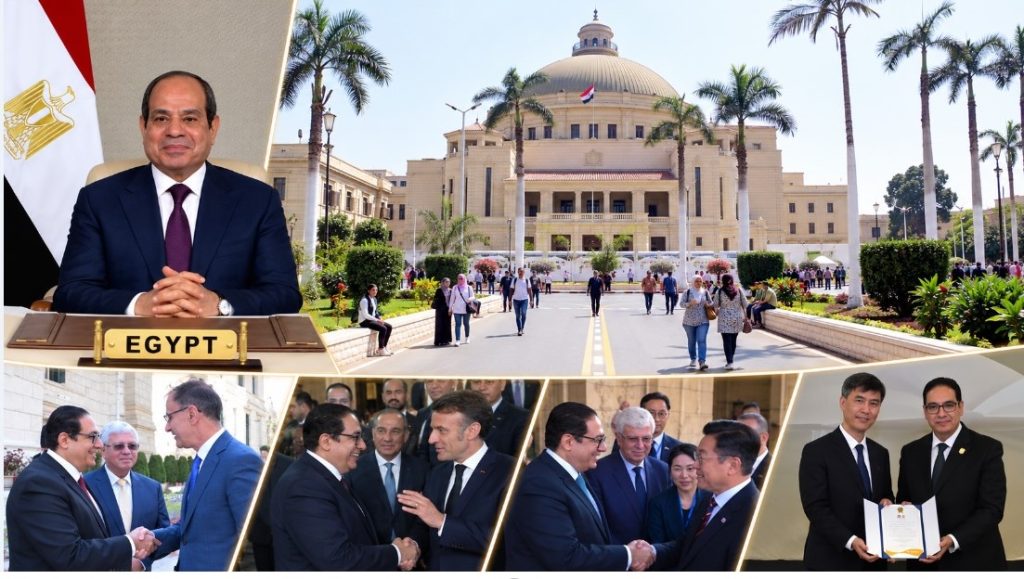
Cairo University no longer derives its international presence solely from its academic history. This presence has become clearly visible through its selection as a host for prominent international figures and leaders, reflecting its position as a platform for dialogue between Egypt and the world. During the recent period, the university hosted a number of international leaders and officials, including French President Emmanuel Macron, South Korean President Lee Jae-myung, Serbian Prime Minister Đuro Macut, as well as 24 ambassadors from different countries. This reflects the expanding international network of the university and its geographical and political diversity. The President of Cairo University has emphasized that each of these visits carries a particular significance and establishes a new path of partnership. The university therefore becomes a space where official diplomacy intersects with academic and research cooperation.
The visit of French President Emmanuel Macron to Cairo University in April 2025 stands out as one of these major international occasions. He was received by the university during the Egyptian-French Universities Forum and delivered a speech in the university’s Great Hall. The event carried symbolic, political, and academic significance simultaneously. Its importance extended beyond its protocol dimension, as it was connected to the development of Egyptian-French university cooperation. The events witnessed the signing of memoranda of understanding and cooperation agreements in several academic and research fields, including joint programs, student and faculty exchanges, and research projects.
The selection of Cairo University as a major stop during the French president’s visit was particularly significant. French and European media highlighted the university’s symbolic status and connected its selection to its academic history and position in the Arab world. The visit was also presented as an occasion to strengthen cooperation in education, culture, and scientific research. In this way, the dome of Cairo University became the setting for an event bringing together Egyptian-French relations and cultural and educational diplomacy.
The Asian Dimension and the Korean Visit
The historic visit of South Korean President Lee Jae-myung to Cairo University added an important Asian dimension to this international presence. The South Korean president chose Cairo University as the first university he visited during his visit to Egypt and delivered a speech before its students, announcing under its dome visions and initiatives aimed at strengthening cooperation between South Korea and the Middle East. He emphasized that students represent an important force in the future of Egyptian-Korean relations.
The visit also connected education with innovation, technology, and cultural exchange, reflecting the transformation of the university into a platform for international dialogue that extends beyond traditional academic cooperation.
The significance of the Korean visit increased because it was not merely a meeting with students; it was also associated with the launch of the SHINE initiative at Cairo University to strengthen cooperation between Korea and the Middle East in the areas of stability, harmony, innovation, networking, and education. The South Korean president also addressed the expansion of academic exchanges, scholarships, cooperation between educational institutions and museums, demonstrating that the university has become capable of hosting and launching initiatives whose dimensions extend beyond higher education to international, cultural, and knowledge cooperation. The visit received extensive coverage from Korean and international media.
Presidential Attention and Historical Standing
This international presence cannot be separated from President Abdel Fattah El-Sisi’s attention to the position of Cairo University and its role within Egypt’s higher education and scientific research system. The university is not only one of the oldest educational institutions in Egypt and the region; it has also become part of a broader approach aimed at strengthening Egyptian universities’ capacity to open internationally, build partnerships, and attract students and researchers. This attention is particularly significant for Cairo University given its historical legacy and scientific and cultural position, making its development and internationalization part of the investment in one of the most important instruments of Egyptian soft power.
This position is rooted in the university’s history extending back to 1908 and in its role in educating generations of scientists, intellectuals, politicians, diplomats, and professionals in Egypt, the Arab world, and Africa. Consequently, hosting national leaders at the university is not merely a passing event; it represents a way of reinvesting this historical legacy in contemporary Egypt’s international presence. When a French or Korean president meets students under the dome of Cairo University, the event conveys a dual message: appreciation for the academic institution on the one hand, and affirmation of Egypt’s scientific and cultural standing on the other.
From Visits to University Diplomacy
The picture is not limited to presidential visits. The university’s international relations have developed into continuous institutional activity. Over two years, Cairo University’s administration met with 180 prominent international universities and participated in approximately 600 regional and international workshops and forums, alongside hosting ambassadors, university leaders, and international figures. This means that the university’s international presence is no longer dependent on exceptional events but has become part of its continuous institutional activity.
More importantly, the university is working to transform international visits and contacts into actionable partnerships. Its participation in the 2026 EAIE Conference in Glasgow demonstrated that its objective is no longer merely to exchange visits, but to move toward joint and dual-degree programs, academic mobility, international research alliances, and attracting more international students. Institutions from the United States, the United Kingdom, Germany, France, the Netherlands, Canada, Malaysia, Belgium, and other countries participated in the conference.
A Platform for Soft Diplomacy
Here the central argument of the study becomes clear: Cairo University has become one of the platforms of Egyptian university diplomacy. Macron’s visit represents the European dimension; the South Korean president’s visit adds the Asian dimension; the reception of ambassadors reflects the diplomatic dimension; meetings with international universities represent the academic dimension; while international students constitute the popular and human dimension of this diplomacy.
When these levels converge within a single institution, the university moves beyond its role as an educational institution to become an Egyptian platform for international communication and for building long-term knowledge-based and cultural influence.
This is directly connected to the concept of soft power, which rests on a state’s ability to attract, persuade, and influence others through culture, values, knowledge, and institutions rather than relying solely on instruments of hard power. In the Egyptian context, Cairo University possesses important elements that enable it to perform this role. It is an institution with a long history, a well-established name in the Arab and African worlds, located in a politically and culturally significant capital with a rich historical legacy. It offers a wide range of disciplines, possesses a substantial research base, and receives students from more than one hundred countries.
Consequently, every international student who chooses Cairo represents, in itself, a new channel of communication between Egypt and the student’s original society. This makes the university one of the important institutional assets of Egyptian soft power.
This trajectory can be described as knowledge diplomacy, in which the university operates not through traditional political channels but through knowledge, education, and scientific research. Such diplomacy possesses an important advantage: continuity. Relationships formed within the university can continue through individuals even after governments and policies change. A student who spends several years in Cairo carries a personal experience of Egypt based not solely on official discourse, but on direct relationships with professors, colleagues, and the society in which the student lived.
The African and Arab Dimensions
Cairo University has a particular opportunity in the African sphere. Egypt’s geographical position and historical relations with the continent, together with the presence of large numbers of African students in Egyptian educational institutions, make Egyptian universities part of the network of Egypt-Africa relations. Attracting African students can therefore serve a dual function: providing high-quality higher education while building future bridges with professionals who may occupy influential positions in their countries. This gives education a strategic dimension within Egypt’s policy toward Africa.
The same applies to the Arab world. The continued presence of Arab students at Cairo University contributes to maintaining an extended cultural and academic network connecting Egypt with Arab countries. The value of this network differs from official relations because it is based on personal and academic relationships that begin within the university and continue after graduation. These relationships may later develop into research, professional, and institutional partnerships.