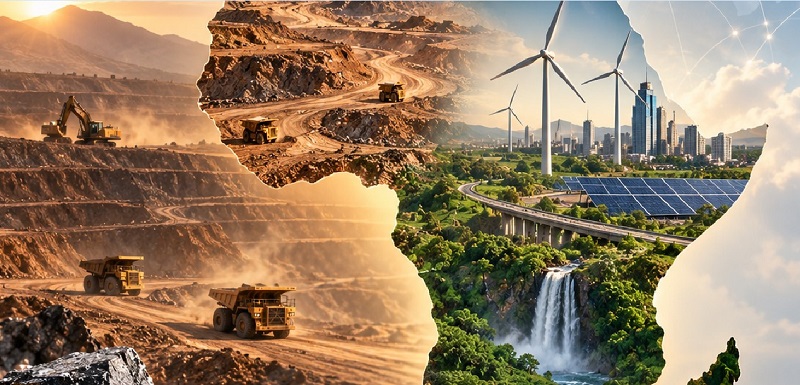
As the global transition toward clean energy, electric vehicles, energy storage, and advanced technologies accelerates, critical minerals have become an essential component of international economic competition. Africa occupies an important position in this equation, not only because of the mineral resources found across the continent, but also because of the diversity of these resources and their distribution among a large number of African countries. Cobalt and copper in the Democratic Republic of the Congo, copper in Zambia, lithium in Zimbabwe and Namibia, graphite in Tanzania, Mozambique, and Madagascar, and platinum-group metals in South Africa all provide the continent with a resource base that could enable it to play a greater role in global critical-mineral supply chains.
However, the possession of natural resources in Africa has historically not been synonymous with economic development. African economies have traditionally relied heavily on exporting raw materials in their primary form, while processing, refining, and manufacturing activities have largely taken place in other countries. This means that a significant share of value added, employment opportunities, and technology transfer leaves the continent along with the raw materials. Therefore, the question is no longer simply: How much critical minerals does Africa possess? Rather, the more important question is: What can Africa do with these minerals before they leave its borders?
This question has become even more important amid the ongoing restructuring of global supply chains. Major countries and corporations are no longer looking only for new sources of raw materials; they are increasingly concerned with supply security, diversification, and reducing the risks associated with dependence on a limited number of countries. The strategic importance of Africa is consequently growing as major economic powers compete to secure access to critical minerals and establish more resilient supply chains.
This competition is particularly visible in the development of the Lobito Corridor, which connects the copper- and cobalt-producing regions of Zambia and the Democratic Republic of the Congo with the Atlantic port of Lobito in Angola. The United States and the European Union, alongside African and international partners, have supported the development of the corridor as a platform for improving connectivity and strengthening critical-mineral supply chains. South Korea has also expanded its engagement with Africa’s critical-minerals sector through enhanced cooperation on critical resources. Seoul has sought to reduce its dependence on a limited number of external suppliers for minerals such as lithium, cobalt, and nickel, which are essential to its advanced industries, including semiconductors, batteries, and electric vehicles. To support this direction, the South Korean government has committed substantial financial resources to Africa, including official development assistance and export financing designed to support Korean companies investing across the continent.
This growing international competition provides Africa with an important bargaining opportunity. However, this opportunity will not be fully realized if the continent continues to treat critical minerals simply as commodities for export. Africa’s real opportunity lies in using growing global demand for these resources to develop local and regional industrial capabilities and increase domestic value added in the sector. The objective should therefore be to move progressively from extraction toward processing, refining, manufacturing, and higher-value technological activities.
The geographical distribution of resources across Africa is particularly important in this regard. Differences in resources and capabilities among African countries can represent a strength rather than an obstacle and could provide a genuine opportunity to develop integrated African value chains. A country that possesses the mineral resource is not necessarily the country best positioned to undertake all stages of processing and manufacturing. Another country may have more competitive energy resources, better ports, stronger industrial infrastructure, or the technical skills required for a particular stage of production. Building African value chains therefore does not require every country to establish an integrated industry extending from the mine to the final product. Instead, different stages of production can be distributed among several countries according to their comparative advantages and capabilities.
Within this framework, Egypt could play an important role in such value chains even though it is not among Africa’s largest producers of critical minerals. Egypt possesses significant mineral resources and potential, including phosphate, gold, black sands, and rare-earth-related resources, in addition to an industrial base, infrastructure, ports, and a geographical position that connects Africa with European and Asian markets. Recent developments in the management and development of Egypt’s non-oil mineral resources also demonstrate the potential of the sector to generate greater developmental outcomes. For example, in June 2025, Phosphate Misr and a Chinese consortium involving CSCEC and ECEC signed agreements to implement a phosphoric acid production complex in the Abu Tartur Plateau, with investments of approximately $658 million and an initial production capacity of 250,000 tons per year. The importance of such projects is not determined solely by the size of the investment, but also by the nature of the investment itself. Such projects link a mineral resource to a higher stage of the value chain instead of simply extracting and exporting the raw material. This is precisely the distinction that Africa should seek in new investments: not simply how much capital enters the mining sector, but what productive capacity, technology, skills, and linkages with the local economy are left behind.
In this sense, foreign investment can be part of the solution, particularly given Africa’s domestic financing gap. However, it can also remain merely a means of resource extraction if there are no clear policies linking investment to industrial development. A project that establishes processing or refining facilities, develops local suppliers, transfers knowledge and technology, and opens new markets for manufactured products has a fundamentally different economic impact from a project that focuses primarily on extracting raw materials and shipping them abroad.
At the same time, numerous African experiences have demonstrated that policies such as banning raw-material exports or encouraging foreign investment are not, by themselves, sufficient to achieve sustainable development. African countries continue to face several challenges in maximizing the benefits of their mineral resources. Limited domestic financing, inadequate technical and technological infrastructure, and economic and political instability remain major obstacles to expanding processing and manufacturing activities across the continent, particularly given the nature of the mining sector and the length of its production cycle. Mining projects can take 10 to 15 years or more from the initial stages of exploration and feasibility assessment to commercial production. This is compounded by the environmental, social, and governance dilemma, particularly in the case of minerals such as cobalt in the Democratic Republic of the Congo, where artisanal and small-scale mining employs millions of people, often under unsafe conditions. This creates a challenge for Western companies seeking to balance their need to secure mineral supplies with strict human-rights and environmental standards.
Governance, transparency, and corruption also remain critical factors in the development of this sector. In addition, governance requirements are no longer limited to traditional social and institutional considerations. The European Union’s increasingly stringent carbon regulations have become an important regulatory and geopolitical factor. With the implementation of the Carbon Border Adjustment Mechanism, companies and manufacturers exporting certain carbon-intensive products to Europe face requirements related to the carbon emissions embedded in those products and their alignment with the European Union Emissions Trading System. These carbon-related costs create a complex financial and technological challenge for Africa’s plans to expand local manufacturing and value addition. The processing and refining of minerals such as aluminum and iron are energy-intensive activities, and given the continent’s continued reliance on relatively carbon-intensive energy sources, these requirements may increase the cost of African manufactured products, potentially affecting their competitiveness in European markets and encouraging exports toward alternative markets with less stringent environmental requirements.
Against this background, recent continental initiatives have acquired particular importance. In July 2026, Abidjan hosted the African Development Bank’s ministerial forum on critical minerals, value chains, and value addition. The focus of the forum was not merely on increasing mineral extraction, but on how mineral resources could be transformed into broader economic and industrial activity within Africa. Participating ministers called for reducing the export of raw minerals, encouraging local processing, and moving toward a more coordinated African approach rather than allowing each country to address the mineral sector separately. This explains the growing emphasis on regional value chains and on leveraging the African Continental Free Trade Area. Greater trade integration can expand the size of the market, make industrial investments more economically viable, and allow production stages to be distributed according to the comparative capabilities of different countries.
The forum also placed human and technological capacity building alongside resource development, value chains, and responsible governance as strategic components of Africa’s minerals agenda. The objective is not simply for Africa to extract more minerals or attract more companies, but to ensure that mineral resources and the revenues generated from them become part of a broader development process, supported by clear investment rules and institutions capable of implementing and monitoring them.
However, the ambition of regional integration often encounters the challenge of limited sovereign coordination. While continental platforms call for a more unified approach under the African Continental Free Trade Area, individual African countries are moving independently to conclude bilateral agreements with competing international powers in order to secure financing and investment. This competition among African countries can hinder the development of shared value chains, as each country may seek to attract processing and refining activities within its own borders rather than distributing them according to geographical and economic comparative advantages. As a result, political and regulatory coordination among African countries may represent one of the greatest challenges to realizing this historic opportunity.
Ultimately, the future of critical minerals in Africa will not be determined solely by the quantity extracted, but by the continent’s ability to retain a larger share of the value generated by these resources. If African countries succeed in combining foreign investment with domestic capabilities, trade integration with manufacturing, and mineral resources with effective governance, critical minerals could become an important pathway toward African industrialization. This may be the real test of Africa’s mineral wealth in the years ahead. The question is no longer simply: Who owns the minerals? Rather, it is: Who can transform them into production, technology, employment, and value added?