

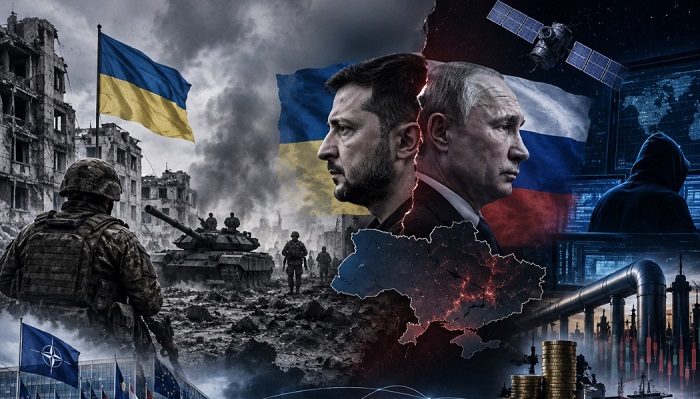
The possibility of an expansion of the Russia–Ukraine war is no longer linked solely to the prospect of Russian forces moving into another European country or NATO forces directly entering the battlefield. The more serious and realistic danger is that the war may gradually expand without a formal declaration, shifting from the conventional military front to a broader network of domains encompassing cybersecurity, intelligence, energy, supply chains, infrastructure, ports, undersea cables, space, the defense industry, and information. It is here that hybrid warfare acquires particular significance, as it allows states to impose strategic costs on their adversaries while, in some cases, remaining below the threshold of direct war.
This trajectory is becoming increasingly dangerous because the boundaries between military action, intelligence operations, and sabotage are becoming less clearly defined. Striking a military facility with a missile constitutes an unmistakable act of war, whereas penetrating an electricity network, disrupting a communications system, or targeting an industrial facility creates a gray zone in which it becomes difficult to determine the nature of the operation, who is responsible for it, and what the appropriate response should be. This gray zone provides the parties with considerable room for maneuver, but at the same time increases the risks of miscalculation. A limited operation can develop into a broader political crisis if it is proven to be linked to a hostile state or results in significant casualties.
In this context, the Russian threat to target British factories producing drones or components associated with Storm Shadow missiles represents an important indicator of the likely nature of the next phase. Even if the threat does not translate into actual military action, merely raising the possibility of conducting a “quasi-military action” against British industrial facilities reveals that Moscow increasingly views the industrial base supporting Ukraine as part of the war system itself. Accordingly, a factory located beyond Ukraine’s borders is no longer viewed merely as a civilian or economic facility; from Moscow’s perspective, it may constitute an element of Ukraine’s military capability that should be influenced or deterred.
The significance of this threat stems from the fact that Britain is not merely providing ready-made weapons to Kyiv; it is also seeking to help Ukraine develop a more sustainable military and industrial capability. From the Russian perspective, the transition from supplying specific weapons systems to transferring knowledge, technology, designs, and production capabilities to Ukraine means that the West is not simply helping to manage the current war, but is contributing to the development of a Ukrainian capability that could remain operational over the long term. Consequently, pressuring the facilities and supply chains associated with these capabilities becomes an attempt to prevent military assistance from evolving into an independent defense-industrial infrastructure.
However, carrying out a direct attack against facilities inside Britain would be an extremely sensitive step, as it could shift the confrontation from supporting a non-NATO member to targeting the territory of a NATO member. For this reason, the primary purpose of such a threat may be deterrence rather than execution: namely, to encourage London to calculate the potential cost of entering a new phase of military cooperation with Kyiv. Nevertheless, the mere use of such rhetoric reflects the widening concept of war-related targets, whereby the geographical front lines inside Ukraine are no longer the sole determinant of the scope of the conflict.
This is where the concept of plausible deniability becomes particularly important. Hybrid warfare allows states to employ tools that can be used indirectly, whether through proxy groups, cyber operations, sabotage, or pressure on supply chains. For Moscow, such tools may be less risky than launching a direct military strike against a NATO member, because they can impose costs on the adversary while reducing the immediate likelihood of an open confrontation with NATO. Western states face a similar dilemma: how can they respond to a hybrid operation without allowing the response itself to raise the level of escalation?
This dilemma makes intelligence attribution one of the most important elements of modern warfare. Demonstrating that a particular state is behind an act of sabotage or a cyberattack is not merely a technical matter; it becomes the basis for the political legitimacy of any response. The more deniable an operation is, the more difficult it becomes to make a decision to retaliate, particularly when retaliation could trigger a chain of countermeasures. Hybrid warfare therefore targets not only infrastructure but also the adversary’s decision-making process, seeking to compel it to spend resources, respond, and act under conditions of uncertainty.
The situation becomes even more dangerous when attacks shift from targeting military forces to targeting the capacity to generate military power. A factory producing missiles or drones, the energy required to operate it, the railways transporting its components, the port receiving raw materials, and the communications networks connecting command-and-control systems have all become interconnected elements of military capability. Consequently, disrupting a single link in this chain can have effects far beyond the scale of the immediate physical damage.
Within this framework, drones have become one of the most important tools reshaping modern warfare. They are no longer merely reconnaissance platforms or limited tactical weapons. They have evolved into systems capable of conducting deep strikes, testing air defenses, exhausting interceptor missiles, gathering intelligence, and operating within increasingly sophisticated swarms or networks. Advances in drone speed, range, maneuverability, and autonomy are making them more difficult to defend against, particularly when large numbers of low-cost systems are combined with more sophisticated weapons.
Artificial intelligence then enters the equation as a force multiplier. The primary value of AI in warfare lies in accelerating target detection, analyzing imagery and data, improving navigation, determining flight paths, and integrating information from multiple sources. As the war continues, the difference between the two sides will depend not merely on possessing a drone or missile, but on possessing a system capable of transforming data into military decisions more rapidly and accurately.
Nanotechnology, meanwhile, is important primarily as an enabling technology rather than as an independent weapon. It can contribute to the development of lighter and more resilient materials, improve batteries, enhance sensors and electronics, and strengthen communications and composite materials. The impact of nanotechnology therefore emerges indirectly by making drones, robots, sensors, and precision weapons more efficient, smaller, and less expensive. This means that technological development in future warfare will not be confined to inventing a new weapon, but will involve improving every component of the combat system.
The war is consequently evolving into an industrial and technological contest. The advantage does not necessarily belong to the actor possessing the most advanced weapon, but rather to the actor capable of producing larger numbers of usable systems rapidly and at low cost, while continuously replacing losses. A relatively inexpensive drone can force an adversary to employ a much more expensive interception system. When repeated on a large scale, this dynamic transforms the confrontation into a war of attrition involving stockpiles, budgets, and industrial capacity. The strategic question therefore becomes: who can produce military technology more rapidly, secure its components, protect its production lines, and rebuild its capabilities after attacks?
Russia, for its part, faces a different challenge. Moscow possesses considerable geographic depth and substantial industrial and military capabilities, but it also confronts a broad Western system capable of providing Ukraine with financial, technological, and industrial support. The conflict is therefore increasingly becoming a competition between two systems: Russia’s ability to produce ammunition and drones and develop electronic-warfare capabilities, and Ukraine and its Western partners’ ability to innovate, manufacture, and continuously replenish their capabilities. The longer the war continues, the more important the defense economy becomes—not merely battlefield performance.
From this perspective, Russian actions toward Britain can be understood as part of an attempt to broaden the deterrence equation. If Moscow believes that continued Western support will enhance Ukraine’s ability to strike deep inside Russian territory, it may seek to impose a corresponding cost on the states providing that support. Yet this approach carries significant escalation risks. The closer operations move toward NATO territory, the greater the possibility that indirect warfare could develop into a direct confrontation.
The issue is not limited to Britain. Some European states’ declining reliance on the Russian security umbrella, as reflected in Armenia’s efforts to reassess the nature of the Russian military presence on its territory and diversify its external partnerships, represents another dimension of the conflict: competition over geopolitical influence. The Russia–Ukraine war has not only affected the balance of power within Europe; it has also encouraged countries in Russia’s neighborhood to reassess their security calculations. From Moscow’s perspective, losing influence in these areas is not merely a political setback; it could become a long-term strategic challenge if Western partnerships expand closer to Russia’s strategic environment.
The expansion of the war is therefore becoming a cumulative process rather than a single decision. It may begin with a political threat, followed by a cyber operation, then the sabotage of a facility, the interception of a drone, casualties inside a European country, and subsequently a retaliatory response. Each individual incident may be containable, but the accumulation of incidents can create an escalation dynamic that becomes increasingly difficult to control. The real danger lies not in one side suddenly deciding to wage war against NATO, but in a sequence of limited operations gradually crossing the threshold that all parties have sought to avoid.
Therefore, the most likely scenario is not a Third World War erupting suddenly, but the continuation of a multilayered conflict: a military front inside Ukraine, an air and missile war, drone warfare, cyber operations, intelligence activities, economic pressure, industrial competition, struggles over energy and infrastructure, and information warfare. Europe will increasingly become part of this equation even without directly deploying its forces into the war.
In my assessment, the greatest strategic challenge in the next phase will not be determining whether the war will expand, but rather defining the limits of that expansion. As Moscow, Kyiv, and their respective partners increasingly move from targeting the battlefield to targeting the systems that generate military power, and as the scope of cyber, sabotage, and intelligence operations expands, the distance between indirect warfare and direct confrontation will become shorter. The Russian threat to target British factories illustrates this point clearly. It may represent a deterrent instrument rather than an indication of an imminent strike, but it simultaneously sends a message that Moscow may increasingly view the industrial infrastructure supporting Ukraine as an extension of the battlefield.
Accordingly, the Russia–Ukraine war is increasingly moving toward a new model of conflict that is no longer defined by maps alone. The struggle now revolves around data, factories, energy, supply chains, semiconductors, drones, artificial intelligence, and the capacity to innovate and manufacture, just as much as it revolves around tanks and missiles.
This may be the defining characteristic of future wars: a lower cost of initiating limited operations combined with a higher cost of controlling the escalation process. The challenge is therefore no longer simply how to wage war, but how to prevent a limited incident from developing into a much larger confrontation.