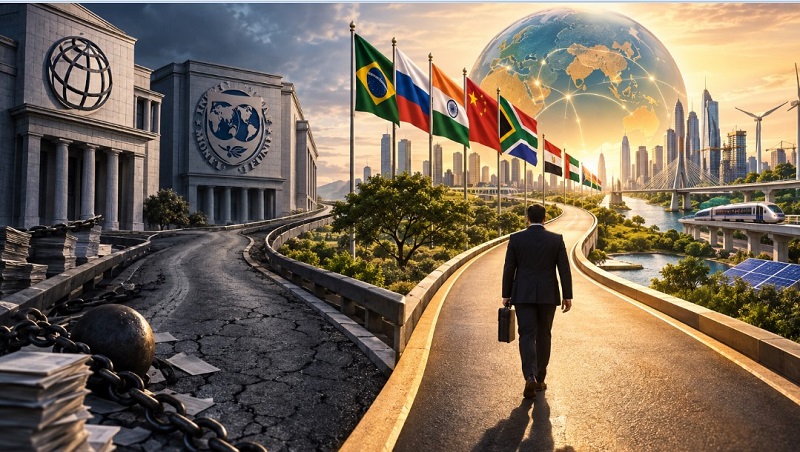
The establishment of the New Development Bank (NDB), established by the BRICS group, is no longer merely an initiative to create an additional financial institution alongside the World Bank and the International Monetary Fund (IMF). Rather, it represents an attempt to redistribute power within the international financial system and establish an alternative more closely aligned with the needs of emerging and developing economies. The bank was established in 2015 at the initiative of Brazil, Russia, India, China, and South Africa, with the objective of mobilizing resources to finance infrastructure and sustainable development projects in BRICS countries and other emerging-market and developing economies. As its membership expands, the NDB has the potential to gradually evolve from a BRICS-affiliated financing institution into a multilateral institution with a broader presence across the Global South.
The significance of examining the NDB’s ability to compete with the World Bank and the IMF lies in the fact that competition does not necessarily imply that the NDB will match these institutions in terms of financial scale, which is unrealistic in the short term. Rather, it involves creating institutional, financial, and political competition that encourages traditional international financial institutions to improve financing conditions, expand their instruments, reduce borrowing costs, and respond more effectively to the priorities of developing countries. The greater the number of financing sources available to countries, the greater their capacity to negotiate and exercise choice. Ultimately, this could contribute to improving development conditions across the Global South.
Capital: The Foundation for Growth
The NDB has authorized capital of $100 billion, while its subscribed capital from the founding member countries amounts to $50 billion. Of this amount, $10 billion constitutes paid-in capital, and $40 billion represents callable capital. The capital shares were distributed equally among the five founding members. This structure provides the bank with a financial foundation that can be leveraged to borrow from international capital markets and subsequently channel resources toward development projects.
The importance of callable capital lies in its role as a fundamental component of the bank’s creditworthiness. The NDB does not rely solely on funds that have already been paid in; it can also draw on the commitments of its member countries to strengthen investor and bondholder confidence. In essence, this mechanism is consistent with the model employed by multilateral development banks, including the World Bank, where paid-in and callable capital provide the foundation for borrowing and lending capacity.
However, the strength of the NDB does not depend exclusively on the contributions of its member countries. The underlying objective of its financial model is to transform capital into a greater capacity to mobilize resources from international markets. Accordingly, the bank has received strong credit ratings since 2018, including an AA+ rating from Standard & Poor’s, an AA rating from Fitch, and an AAA rating from the Japan Credit Rating Agency. These ratings enable the bank to borrow at relatively lower costs and subsequently channel resources into development projects.
Where Does the Financing Come From?
The bulk of the NDB’s financing capacity derives from capital markets rather than solely from contributions by its member countries. The bank issues bonds in international and domestic markets and in various currencies. It also borrows from financial institutions, bilateral lenders, and syndicated banking facilities. In 2024, the bank raised the equivalent of $8.7 billion through a diverse range of financing instruments, including public and private bond issuances, as well as credit facilities provided by bilateral and syndicated lenders.
These figures reveal a critical point: the founding member countries are no longer the sole source of the resources utilized by the bank. Member states provide the capital, after which the bank leverages its creditworthiness in international markets to attract savings from investors, investment funds, central banks, financial institutions, and insurance companies. These resources are then transformed into loans for infrastructure, energy, water, transportation, and sustainable development projects.
This is the model that could enable the NDB to become a genuine competitor in the future: sovereign capital, strong credit ratings, access to borrowing from capital markets, and the subsequent on-lending of resources to developing countries. Through borrowing operations and sound financial management, every dollar contributed by member countries to the bank’s capital can help mobilize several additional dollars from financial markets.
Currency as a Competitive Instrument
One of the NDB’s most important strategic strengths is its growing emphasis on financing in local currencies. This aspect may be more significant for the Global South than simply increasing the volume of lending, as borrowing in US dollars or euros exposes developing countries to substantial risks when their domestic currencies depreciate or global interest rates rise.
In January 2025, the bank issued a five-year panda bond worth 6 billion yuan at an interest rate of 1.7%. At that time, its cumulative panda bond issuance had reached 61.5 billion yuan. In August 2025, the bank issued an additional bond worth 7 billion yuan, bringing total panda bond issuance to 75.5 billion yuan.
By December 2025, cumulative panda bond issuance had reached 78.5 billion yuan, of which 47.5 billion yuan remained outstanding. The bank continued to utilize local-currency markets to reduce foreign-exchange risks and develop domestic capital markets. It also announced a target of increasing the share of financing denominated in the national currencies of its member countries to 30% of its total financing commitments.
This highlights one of the most significant areas of potential competition with traditional financial institutions. If a developing country can secure long-term financing in its own currency, it can reduce its exposure to dollar-related shocks. Consequently, the cost of a development project becomes less sensitive to exchange-rate fluctuations.
Expanding Operational Scale
Data from the New Development Bank indicate that, in 2024, the bank approved 15 projects with a total value of $4.511 billion. By the end of that year, its portfolio comprised 105 projects, with total approved financing amounting to $35.152 billion.
In 2025, the bank approved 19 projects valued at $3.171 billion. The number of projects in its portfolio increased to 115, while total approved financing reached $35.593 billion.
These figures confirm that the NDB remains considerably smaller than the World Bank in terms of scale. At the same time, however, they demonstrate the bank’s continued institutional growth. Furthermore, a cumulative portfolio approaching $36 billion indicates that the NDB has moved beyond its establishment phase and begun building a substantive portfolio of development projects.
Where Does the Gap with the World Bank Lie?
A numerical comparison clearly demonstrates that the NDB is not currently in a position to compete with the World Bank in terms of financial scale. Total commitments by the World Bank Group reached approximately $161.9 billion in fiscal year 2025, including $40.9 billion from the International Bank for Reconstruction and Development (IBRD), $39.9 billion from the International Development Association (IDA), and $71.7 billion from the International Finance Corporation (IFC).
Subscribed capital in the IBRD stood at approximately $326.8 billion as of June 2025, including $22.9 billion in paid-in capital. Meanwhile, during fiscal year 2025, the IBRD raised $64.5 billion through medium- and long-term debt issuance.
Accordingly, discussions of competition between the NDB and the World Bank should be based on a different understanding of competition. The primary question is not which institution possesses greater financial resources, but rather which one offers a financing model that is more appropriate to the needs of developing countries.
Competition with the International Monetary Fund
The situation is more complex in the case of the International Monetary Fund because the mandates of the two institutions differ. The IMF focuses primarily on balance-of-payments stability, public finances, and the international monetary system, whereas the NDB concentrates on infrastructure and sustainable development. Consequently, direct competition between the two institutions is limited. Nevertheless, indirect competition may emerge over financing sources and the conditions attached to them.
The IMF relies primarily on the quotas of its member countries, which constitute the principal permanent source of its resources. It can supplement these resources through multilateral and bilateral borrowing arrangements. According to IMF data, New Arrangements to Borrow (NAB) amounted to approximately 364.4 billion Special Drawing Rights (SDRs) in April 2025, while effective commitments under bilateral borrowing agreements stood at 118.5 billion SDRs at that time.
The NDB can offer a different financing pathway. Rather than allowing financial crises to serve as the primary entry point for financing, investment in infrastructure, energy, transportation, water, and digital transformation can become a means of preventing crises in the first place and promoting long-term economic growth.
The Absence of Conditionality as a Competitive Advantage
One of the NDB’s most significant features is its stated emphasis on providing financing solutions tailored to the needs of its member countries, without policy conditions comparable to those typically associated with economic reform programs. The bank’s strategy indicates that the needs of member countries and clients constitute a central consideration in its operational approach, with an emphasis on providing suitable financial products and services.
This approach could become a significant competitive advantage in the Global South, particularly for countries seeking infrastructure financing without wanting access to loans to entail extensive restructuring of their economic policies.
However, for this advantage to translate into genuine success, the absence of policy conditionality must not imply the absence of financial discipline, transparency, good governance, or rigorous feasibility assessments. Sustainable competition is not based on providing easy loans; rather, it requires offering financing that is timely and flexible while maintaining project quality and ensuring borrowers’ repayment capacity.
Egypt and the Global South
Egypt’s membership in the New Development Bank since February 2023 represents an important opportunity to apply this model within developing economies. Moreover, the accession of new members expands the bank’s operational base and enlarges the market in which it operates, enabling the diversification of risks, sources of capital, and investment opportunities. Algeria joined the bank in May 2025, while Egypt, Bangladesh, the United Arab Emirates, and Uruguay had previously become members.
As membership expands, the bank becomes less closely associated with the narrow concept of a “BRICS bank” and more capable of evolving into a financing platform for the Global South. This transformation could enhance its negotiating position vis-à-vis established international financial institutions.
Toward a Three-Pillar Competitive Model
The future international financial system can be envisioned as comprising three complementary financing pathways: the World Bank as a provider of global development financing, the IMF as an institution responsible for financial and monetary stability, and the NDB as an additional source of infrastructure and development financing for emerging economies. This does not imply the elimination of existing institutions; rather, it points toward the creation of a more pluralistic financial environment.
The World Bank itself is currently seeking to expand its financing capacity through new instruments, guarantees, hybrid capital, and portfolio guarantee platforms, in addition to mobilizing private capital. The bank has indicated that these instruments could generate nearly $20 billion in additional lending capacity over a ten-year period, alongside the use of additional guarantees to generate approximately $10 billion in lending capacity.
The emergence of the NDB, therefore, does not merely place pressure on established institutions; it also encourages them to innovate and adapt. This constitutes the broader benefit of institutional competition.
Conclusion
The success of the New Development Bank in creating genuine competition will not depend on its attempt to replicate the World Bank or the International Monetary Fund. Rather, it will depend on its ability to establish a distinct model of development financing. The key components of this model include an authorized capital base of $100 billion, strong credit ratings, reliance on international and domestic capital markets, currency diversification, expanded financing in national currencies, the issuance of green and sustainable bonds, and a focus on infrastructure and sustainable development.
The NDB’s true advantage does not lie in its current ability to surpass the World Bank in terms of financing volume, as the gap between the two institutions remains substantial. Instead, its significance lies in its ability to provide developing countries with an additional financing option. If the bank succeeds in offering faster financing, competitive costs, longer maturities, and local-currency lending while maintaining creditworthiness, sound governance, and transparency, it will not need to replace the World Bank or the IMF in order to succeed.
The ultimate measure of success will be whether the NDB enables a developing country to say: I have more than one source of financing, more than one development model, and more than one negotiating option. When competition reaches this stage, the principal beneficiaries will not be the NDB alone, nor the World Bank or the IMF, but developing countries and the Global South as a whole.