
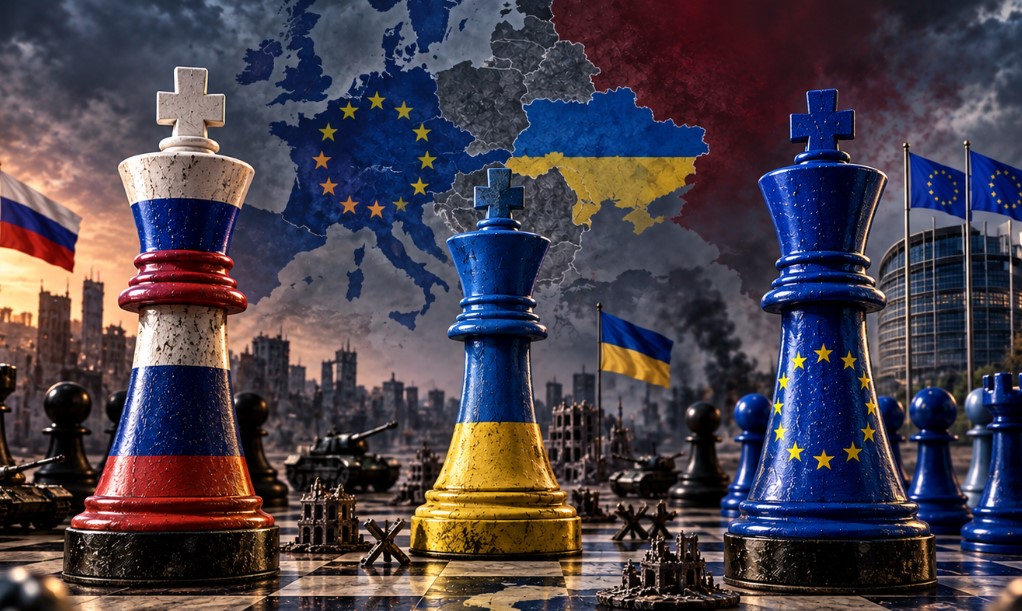
The Russian-Ukrainian war is one of the most complex crises in the international system, with profound implications for the balance of power, the future of the European security order, the position of the United States, and relations between Russia and the West. Since Moscow launched what it described as the “special military operation” in the early hours of February 24, 2022, initial assessments suggested that the war would be swift and decisive and would end within a short period. Reality, however, proved otherwise. The confrontation evolved into a protracted war that has entered its fifth year, raising questions that go beyond the military battlefield to the nature of the security and political order that will emerge from this crisis, who will bear the cost of the settlement, who will obtain security guarantees, and whether the United States can impose a settlement on Moscow and Kyiv, or whether the most it can do is manage negotiations, narrow differences, and bridge the gaps between the two sides.
Through my doctoral dissertation in International Relations at the Faculty of Economics and Political Science, Cairo University, entitled “Russian Foreign Policy toward Ukraine and Its Impact on Russian-European Relations,” it becomes clear that the crisis is highly complex and that no one-sided reading can provide a genuine and realistic explanation of its nature. It is the product of a long historical legacy, a Russian-Western geopolitical conflict, a Ukrainian sovereignty struggle, Russian national security calculations, American and European interests, as well as a broad restructuring of the international system.
Understanding the war therefore requires viewing international politics as an interaction between states’ interests, security concerns, balances of power, and their ability to protect their vital interests, alongside the historical, political, economic, cultural, social, and geostrategic determinants that contributed to its outbreak. This requires going back to the roots of the crisis rather than focusing only on the beginning of military operations in February 2022.
Russia views the period following the collapse of the Soviet Union as one in which the European security architecture gradually shifted eastward, with the expansion of NATO and the accession of countries that had previously belonged to the Soviet sphere. The Russian leadership believes that this expansion changed the security environment surrounding Russia and that the arrival of Western military and security structures at its borders represents a direct threat to its national security. Moscow considers Ukrainian membership in NATO a red line that cannot be crossed and rejects the presence of advanced Western military and security infrastructure directly on its borders.
From this perspective, Russia cannot separate its national security from the surrounding security environment. Moscow argues that the military operation was launched to protect its national security, prevent Ukraine from becoming a strategic base for the West, and halt NATO’s continued eastward expansion. It also demands Ukrainian neutrality, the removal of military capabilities that Moscow considers a threat, protection for populations of Russian origin in eastern regions, and control over territories that it considers part of its security and strategic interests. Moscow also bases its narrative on the failure to implement the Minsk agreements, particularly Minsk I and Minsk II, which were reached with the aim of resolving the crisis in eastern Ukraine.
However, reducing Russia’s position to a desire to control Ukrainian territory represents a fundamental mistake in analyzing the nature of the war. Territory is certainly important, but it is not the whole story. There are four principal levels of Russian interests.
The first is the security dimension, in which Moscow seeks to ensure that Ukraine does not become an advanced Western military platform on its borders. The second is the geopolitical dimension, through which Russia seeks to preserve its position as a major power capable of influencing its European neighborhood and the international system more broadly. The third is the regional dimension, as Moscow views the loss of its influence in Ukraine as a major strategic shift in the balance of power in Eastern Europe. The fourth is the domestic and political dimension, because retreating without obtaining results that can be presented to the Russian public as strategic gains would impose a significant political cost on the Russian leadership. Accordingly, any settlement requiring Moscow to withdraw completely without substantial security and political compensation appears extremely difficult.
On the other hand, Ukraine, the United States, and European countries view Russia as having used military force against a sovereign state and consider the core of the crisis to be Moscow’s attempt to impose its will on Kyiv’s foreign, security, and regional choices. NATO has repeatedly affirmed its support for Ukraine’s right to choose its security arrangements and remains committed to Ukraine’s sovereignty and territorial integrity within its internationally recognized borders.
Herein lies the fundamental paradox of the war: Russia speaks of its national security, while Ukraine speaks of its national sovereignty. Between Russian national security and Ukrainian sovereignty, a war that was expected to end quickly has continued into its fifth year without a genuine settlement.
To provide a more objective assessment, it is necessary to examine NATO’s position. The alliance maintains that it is a defensive alliance and does not seek confrontation with Russia, and that the strengthening of its capabilities came in response to the new security threats created by the war. Moscow, by contrast, argues that Western security policies, NATO’s military expansion, and military exercises in Eastern Europe preceded the war and contributed to creating the security environment that led to escalation.
While NATO considers Russia’s war against Ukraine the most serious threat to Euro-Atlantic security in decades, Moscow views the matter differently. It argues that the strategic outcome of the war has been to make Ukraine more closely integrated with Western institutions and that Western military support for Kyiv has become a permanent factor in the security equation.
A significant paradox therefore emerges: Russia sought through the war to prevent the Western security architecture from moving closer to its borders, while the war has practically resulted in greater NATO cohesion and stronger European military capabilities, making the European security environment more stringent toward Russia. Moscow is therefore not negotiating with Ukraine alone; it is indirectly dealing with a broader Western security architecture.
As for Ukraine, its refusal to surrender territory is not merely a border dispute. The Ukrainian leadership considers it an existential issue concerning the state itself. From Kyiv’s perspective, accepting territorial concessions imposed by force could establish the principle that changing borders through force can become acceptable in international relations.
There is also a highly important domestic political factor. Any Ukrainian leadership that formally accepts the surrender of large areas of territory would face a severe political and popular crisis. Kyiv therefore wants to enter any negotiations from a military and political position that allows it to secure the best possible terms.
This helps explain one of the most important principles of negotiation in this war: each side seeks to improve its military position before making political concessions. Therefore, the continuation of fighting does not necessarily mean a rejection of peace in principle. Rather, it means that each side believes that time may improve its negotiating position.
One of the most dangerous developments in the current phase of the war is the expansion of reciprocal strikes. Ukraine has become increasingly capable of striking targets deep inside Russian territory after receiving long-range missiles from Western allies, while Russia continues its missile and drone attacks against Ukrainian cities and infrastructure. September 2026 witnessed a notable development, with Ukraine announcing long-range strikes against facilities linked to Russia’s energy and gas sector, alongside an intensification of Russian air attacks against Ukrainian territory.
This development carries major strategic significance because the war’s movement into the Russian interior means that Kyiv no longer seeks merely to defend its front lines; it is also attempting to increase the cost of the war for Moscow. However, expanding the geographic scope of attacks also carries increasing risks. The broader the targeted geography becomes, the greater the possibility of miscalculation and unintended escalation, making the United States’ task more difficult.
The United States is the party that possesses, to a considerable extent, tools of pressure over both Russia and Ukraine. Washington can exert economic and political pressure on Moscow and can influence the level of military support provided to Kyiv through the provision or withholding of air-defense systems and advanced weapons. It also has the ability to offer security guarantees, open direct channels of communication with Moscow, and sponsor a comprehensive political agreement.
However, possessing tools of influence does not mean possessing the ability to impose peace. Here, it is necessary to distinguish between mediation and imposing a settlement. The United States can push both sides toward the negotiating table, but it cannot easily force Russia to abandon all of its demands, nor can it force Ukraine to accept territorial concessions.
Therefore, America’s real power does not lie in its ability to write the agreement, but rather in its ability to alter the cost-benefit calculations of the two sides.
The information presented in the article indicates that the United States has attempted to revive the negotiating track. In September 2026, U.S. envoys Steve Witkoff and Jared Kushner held contacts with Moscow and Kyiv, and new ideas were put forward with the aim of restarting negotiations. Kyiv also spoke of ideas it described as positive, while fundamental disagreements remained unresolved.
Ideas also emerged concerning de-escalation measures during the winter, as well as discussions on energy, grain, and prisoner exchanges, in an attempt to build partial agreements that could pave the way toward a broader settlement. However, the latest contacts did not achieve a decisive breakthrough.
This is an important point because the existence of negotiations does not necessarily mean that a settlement is imminent. Sometimes negotiations begin when the parties reach a stage at which continuing the war becomes increasingly costly, but they require considerable time to agree on the distribution of gains and losses.
The territorial issue remains the key to any settlement. Russia wants to retain the areas it controls and considers them part of its strategic interests, while Ukraine rejects recognition of the surrender of its territory. Current information indicates that disagreements over the territories of Donbas, particularly Luhansk and Donetsk, as well as the other regions annexed by Russia and subject to dispute, remain the main obstacle to a settlement.
Russia argues that the war cannot end without addressing the issues of territory and security, while Ukraine maintains that peace cannot be based on recognizing the annexation of territories by force. The United States is attempting to find a middle ground between the two positions.
In the search for a settlement, a formula has been proposed based on a ceasefire and the freezing of lines of control, without immediate legal recognition of the final status of the territories, followed by long-term negotiations over the final status of the disputed areas. At the same time, discussions have focused on security guarantees for Ukraine and security arrangements for Russia.
If successful, this formula could be closer to a long-term strategic truce than a final peace treaty, or what might be described as a freezing of the conflict.
Here, it is necessary to distinguish between ending the war and resolving the conflict. Even if a ceasefire is agreed upon, the most important question remains: What comes next?
Ukraine wants guarantees preventing a recurrence of the war. Russia wants guarantees preventing Ukraine from becoming a Western military base. Europe wants to avoid finding itself facing another war several years later, while the United States wants an agreement that can be defended politically and strategically.
We are therefore facing a four-dimensional equation involving Russia’s security, Ukraine’s security, European security, and U.S. interests. It is extremely difficult to fully achieve all four objectives.
If Russia receives genuine Ukrainian neutrality, guarantees against the deployment of NATO combat forces on Ukrainian territory, and long-term security arrangements, it may become more willing to accept a ceasefire. The problem, however, is that Ukraine does not want neutrality to turn it into a weak state incapable of defending itself.
This could lead to a compromise formula under which Ukraine does not join NATO but receives strong Western security guarantees and maintains a powerful national army, alongside agreed restrictions on certain forms of foreign military deployment. This is one of the most realistic formulas if the parties genuinely seek a settlement.
At the same time, the United States faces three major constraints that make imposing a solution extremely difficult.
The first is that Russia is not a small country that can easily be subdued. It is a major nuclear power with substantial economic, military, and human resources, and the Russian leadership regards the conflict as a matter of national security.
The second is that Ukraine is not merely an American bargaining chip. Kyiv has its own calculations, interests, and sacrifices, and therefore will not necessarily accept any agreement it considers contrary to its national interests.
The third constraint is that Europe has become a central party. The war has redefined European security, and European states now have direct interests in its outcome. Therefore, any U.S.-Russian agreement that does not take Europe and Ukraine into consideration would be difficult to implement.
From a realist perspective, the United States seeks to achieve several objectives simultaneously: preventing a complete Russian victory; avoiding a direct war between Russia and NATO; preserving the independence of the Ukrainian state; preventing the conflict from spreading to other countries; reaching a settlement that reduces the American and European costs; rebuilding a degree of stability in Europe; preventing Russia from imposing a complete security order on Europe by force; and, at the same time, avoiding an open-ended war of attrition.
This highlights the importance of U.S. policy, which combines support, pressure, and negotiation.
Russia, for its part, also faces the dilemma of achieving a complete victory. Despite its strength, achieving all of its war objectives through military force has become increasingly difficult. Ukraine remains capable of fighting and continues to receive extensive Western support. It has also developed its capabilities in drone warfare and long-range strikes.
At the same time, Russia does not appear prepared to withdraw without clear political and security gains. The war has therefore reached what can be described as an “unstable balance.”
Russia cannot easily achieve all of its objectives, Ukraine cannot easily recover all of its territory by force, the United States cannot end the war through a unilateral decision, and Europe cannot sustain an endless war.
This is precisely what makes negotiations ultimately inevitable.
If the negotiating track fails, the war may continue, but that does not necessarily mean that it will continue at the same intensity as today. This war will not end solely on the Ukrainian battlefield because, at its core, it is a struggle over the shape of Europe in the twenty-first century and the nature of the international security order in the post-Cold War era.
Russia wants a security environment in which it does not feel surrounded. Ukraine wants an independent state whose choices cannot be imposed upon it by a major power. NATO wants to preserve a cohesive European security architecture. Meanwhile, the United States seeks to prevent changes to the rules of the international system through force, while simultaneously avoiding an open conflict between nuclear powers.
The key to a solution, therefore, is not for one side to achieve complete victory, but for the parties to reach the point at which peace becomes less costly than continuing the war.
The United States has the greatest capacity to push the parties toward that point, but it does not have the ability to create peace on its own. Washington can open the door, but it cannot walk through it alone.
At the same time, Russia must recognize that any future security arrangements in Europe will not be stable without addressing the concerns of European states and Ukraine.
Ultimately, the realistic vision of the crisis can be summarized in one equation: There can be no lasting peace without security guarantees, no security guarantees without a political settlement, no political settlement without mutual concessions, and no mutual concessions without an American role capable of managing the balance of power.
Therefore, the question is no longer: “Who will win the Russian-Ukrainian war?”
It has instead become: “Who can transform the outcomes of the war into a viable political settlement?”
This is precisely where the importance of the American role lies. If Washington succeeds in moving from managing the war to managing the settlement, one of the most significant processes of restructuring the European security order since the end of the Cold War may begin.
However, if American diplomacy fails to address the issues of territory and security guarantees, as well as Russia’s concerns and Ukraine’s demands, the war may enter an even longer phase of attrition and could continue for several more years, even if its intensity and form change.
The war may end before the conflict is resolved, and the ceasefire may come before peace is born.