

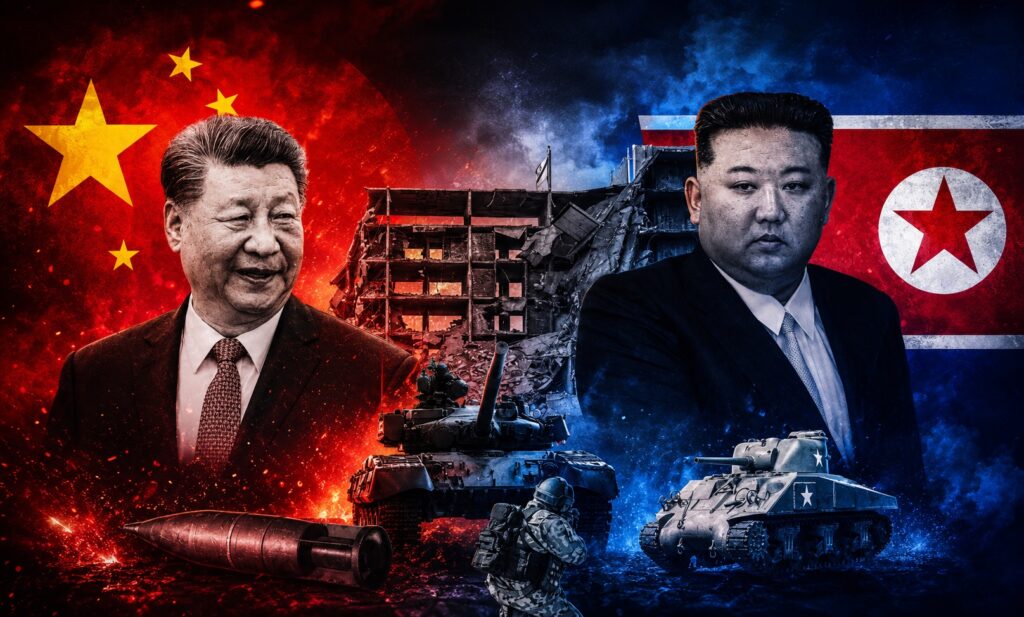
In a world rapidly moving toward a restructuring of international power balances, relations between states are no longer measured solely by trade volumes or diplomatic coordination. Instead, they are increasingly understood through their position within the escalating global competition among major powers. In this context, the growing rapprochement between China and North Korea stands out as one of the most significant geopolitical developments in East Asia in recent years. A relationship that began more than seven decades ago in the aftermath of the Korean War is once again moving to the forefront, but under dramatically different international circumstances characterized by intensifying U.S.–China competition, expanding economic and technological confrontation between Washington and Beijing, and the deepening military and political partnership between Moscow and Pyongyang. These developments raise an important question: are China and North Korea reviving their traditional alliance, or are they constructing a new strategic partnership aimed at reshaping Asia’s security architecture?
The significance of this question has grown amid recent political developments and increasing discussions about a potential visit by Chinese President Xi Jinping to North Korea. Such a visit would carry implications far beyond bilateral relations, touching on issues related to North Korea’s nuclear program, the future of the U.S. military presence in the region, the limits of Russian influence in Pyongyang, and China’s role in any future security or diplomatic arrangements concerning the Korean Peninsula. Beijing views North Korea as the primary geopolitical buffer protecting its northeastern frontier, while Pyongyang sees China as its most important strategic guarantor against international sanctions and external pressure.
Several critical questions therefore emerge. Why is China intensifying its relationship with North Korea at this particular moment? What interests are driving both sides toward closer cooperation? Does Beijing remain merely a political and economic ally, or does it contribute directly or indirectly to strengthening North Korea’s nuclear capabilities? How extensive is China’s influence within North Korea’s decision-making circles? Can North Korea become a strategic card used by China in its broader competition with the United States, or does the relationship signal the emergence of a new geopolitical bloc challenging the U.S.-led international order that has prevailed since the end of the Cold War?
Understanding the trajectory of China–North Korea relations is no longer simply a matter of examining ties between neighboring states. Rather, it has become a lens through which to understand profound transformations occurring throughout the international system. Nuclear calculations intersect with economic rivalries, national security concerns overlap with competition for global influence, and Chinese, North Korean, Russian, and American interests converge in a complex strategic environment. As a result, the relationship between Beijing and Pyongyang has become one of the key factors shaping the future of Asia and the global balance of power in the decades ahead.
Historical Roots
To understand the current rapprochement, it is necessary to revisit the historical foundations of the relationship. China played a decisive role in preserving the North Korean regime during the Korean War (1950–1953), deploying hundreds of thousands of troops to prevent Pyongyang’s collapse before U.S.-backed forces. From that moment, the two countries developed a unique relationship that extended beyond a conventional alliance and evolved into a security and strategic partnership rooted in mutual survival. Beijing viewed North Korea as a geographic and political buffer preventing American influence from reaching its borders, while Pyongyang regarded China as the primary guarantor of regime survival. This relationship was institutionalized through the 1961 Treaty of Friendship, Cooperation, and Mutual Assistance, which remains the most important legal framework governing bilateral ties today.
Strategic Geography
Chinese leaders recognize that North Korea’s geopolitical location grants it exceptional strategic value. Situated between China, South Korea, and Japan, North Korea lies at the center of one of the world’s most sensitive military regions. Beijing therefore considers North Korea a buffer zone separating Chinese territory from U.S. forces stationed in South Korea and limiting the expansion of Western influence toward China’s northeastern frontier. Consequently, preserving the North Korean regime is not merely a diplomatic concern for Beijing; it is a core national security interest. The collapse of the regime could potentially lead to Korean reunification under a government closely aligned with Washington, a scenario China views as a direct strategic threat.
Chinese Motivations
China’s current outreach to North Korea cannot be separated from its growing tensions with the United States. Beijing faces mounting pressure over trade, technology, semiconductors, Taiwan, and the South China Sea, while Washington continues strengthening a network of alliances that includes Japan, South Korea, Australia, and the Philippines. Against this backdrop, China seeks to reinforce its strategic leverage, and North Korea represents one of its most valuable assets. While Pyongyang may not be capable of directly challenging the United States militarily, it serves as a persistent source of strategic distraction that forces Washington to divide its attention and resources across multiple fronts.
Russian Concerns
One factor motivating China to revitalize its relationship with Pyongyang is the dramatic expansion of Russia–North Korea ties in recent years. Following the war in Ukraine, North Korea emerged as an increasingly important military and political partner for Moscow. This development raised concerns within Chinese strategic circles about the possibility of diminishing Chinese influence in North Korea. Beijing therefore appears determined to reassert its presence and prevent Pyongyang from drifting into a sphere of Russian dominance. From China’s perspective, losing influence in North Korea would mean losing one of its most important strategic tools in East Asia.
Mutual Dependence
North Korea’s dependence on China is no less significant than China’s strategic interest in North Korea. Beijing remains Pyongyang’s largest trading partner and its primary source of energy, food, and essential goods. Much of North Korea’s economic activity relies on trade conducted through the Chinese border. Consequently, any significant shift in Chinese policy would directly affect North Korea’s domestic economic stability. For this reason, Kim Jong Un seeks to maintain stable relations with Beijing even while strengthening ties with Moscow. North Korean leaders understand that Russia may provide valuable military and political support, but it cannot replace China’s economic and geographic importance.
The Nuclear Issue
North Korea’s nuclear program remains the most complicated aspect of the bilateral relationship. Officially, China opposes nuclear proliferation and supports the denuclearization of the Korean Peninsula. Beijing has also participated in international sanctions following North Korea’s nuclear tests. In practice, however, China’s position is more nuanced. Beijing does not want North Korea to develop an unlimited nuclear arsenal that could trigger a regional arms race, but neither does it want to apply pressure severe enough to destabilize or collapse the regime. As a result, China has adopted a strategy focused on managing the crisis rather than resolving it and containing the nuclear program rather than eliminating it entirely.
Indirect Support
There is no documented evidence that China has directly assisted North Korea’s nuclear weapons development or transferred nuclear technology to Pyongyang. Nevertheless, many Western analysts argue that Beijing has indirectly supported the regime by maintaining trade flows, mitigating the impact of sanctions, and preventing the adoption of more severe measures within the United Nations Security Council. Such actions have helped North Korea preserve domestic stability while allocating resources toward military, missile, and nuclear programs.
Strategic Dilemma
China faces a difficult strategic dilemma. On one hand, it does not want North Korea to possess a highly advanced nuclear arsenal that could increase regional tensions and encourage Japan and South Korea to expand their own military capabilities. On the other hand, Beijing fears the consequences of regime collapse, including border instability, refugee flows, and the potential expansion of American influence up to China’s borders. As a result, China has spent years navigating a gray area between pressure and support, deterrence and containment.
Anticipated Visit
A possible visit by President Xi Jinping to Pyongyang would carry significance beyond diplomatic protocol. It would occur amid heightened regional tensions and evolving developments related to North Korea’s nuclear program and its relationship with Russia. Such a visit would send multiple messages: to Washington, that China remains the most influential actor in Korean affairs; to Moscow, that North Korea remains within China’s strategic sphere; and to Pyongyang, that Beijing remains committed to preserving their historic partnership despite emerging complexities.
American Response
The United States is closely monitoring this rapprochement because closer China–North Korea ties would further complicate East Asia’s security environment and create additional challenges for Washington’s strategy of containing China. From the American perspective, stronger ties between Beijing and Pyongyang could provide North Korea with greater room for political and military maneuvering while reducing the effectiveness of international sanctions. Consequently, Washington continues expanding military cooperation with South Korea and Japan and strengthening regional deterrence frameworks.
Economic Competition
The China–North Korea relationship cannot be separated from the broader economic and technological confrontation between China and the United States. As Washington intensifies restrictions on Chinese technology, advanced semiconductors, and exports, Beijing increasingly values partnerships that can support its long-term strategic resilience. Within this framework, North Korea becomes part of a broader Chinese strategy aimed at reducing the impact of American pressure and strengthening China’s ability to withstand efforts at containment.
Future Negotiations
Although China is not a direct participant in North Korea’s nuclear program, no future negotiations concerning the issue are likely to succeed without Beijing’s active involvement. China possesses political and economic leverage over North Korea unmatched by any other country, and North Korean leaders recognize Beijing as the most important guarantor of any future security arrangements. Therefore, any new diplomatic process will almost certainly require a central Chinese role, whether direct or indirect.
A New Balance
At its core, the China–North Korea rapprochement is about far more than bilateral interests. It reflects deeper structural shifts taking place throughout the international system. As the world gradually moves away from an era of unipolar American dominance toward a more complex distribution of power, China seeks to build networks of influence capable of protecting its interests and countering Western pressure. North Korea, meanwhile, seeks to leverage these changes to consolidate its position as a nuclear power that cannot be ignored. Viewed in this context, the current rapprochement appears less like a temporary alliance of necessity and more like part of a broader process of strategic realignment in East Asia—one whose consequences could shape regional security and global power dynamics for decades to come.