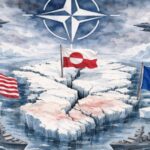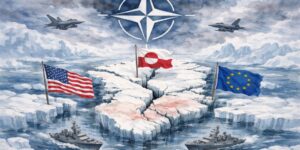

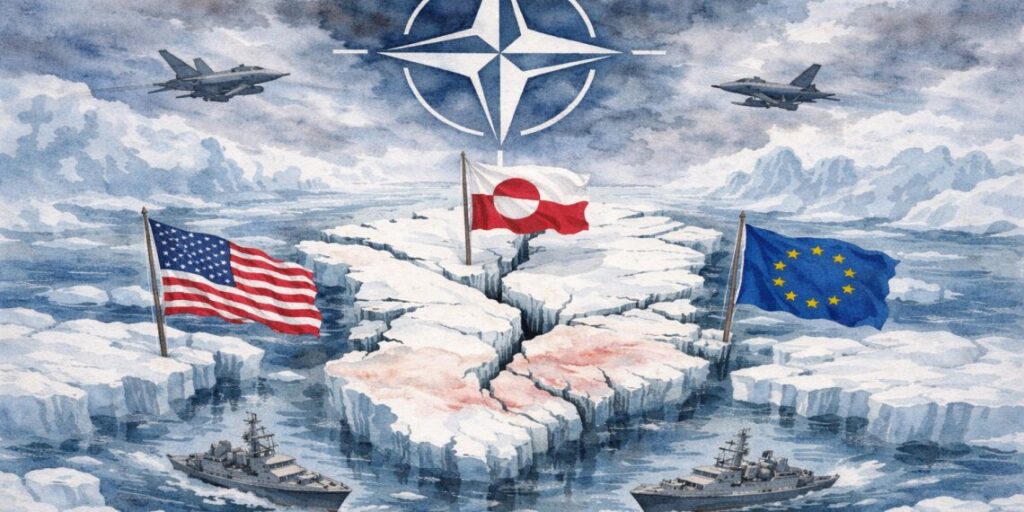
The Atlantic space witnessed an unprecedented escalation at the beginning of 2026, following US President Donald Trump’s announcement of his intention to annex Greenland, a Danish territory, to the United States. This move represented a clear departure from the established norms governing relations between allies within NATO. This proposal coincided with US threats to impose tariffs on eight European member states of the alliance if they failed to reach an agreement transferring sovereignty over the island to Washington.
The American pressure took on a multifaceted character, extending beyond the economic sphere to encompass security and symbolic dimensions. This included the threat of deploying the “Golden Dome” missile defense system over Greenland, along with the recirculation of maps and geopolitical projections depicting a reshaping of the US geographical sphere to include Greenland, Canada, and Venezuela. This reflects an American approach seeking to redefine the concepts of national security and vital space, even at the expense of traditional consensus within the Western system.
Tensions deepened within the European-American camp when Trump, during his participation in the World Economic Forum in Davos, revived the idea of “buying Greenland” as a strategic option, emphasizing the use of tariffs as a tool of political pressure on allies. These statements were met with rejection from Europe, with EU leaders stressing that any infringement on Greenland’s status constitutes a direct violation of the sovereignty of the Kingdom of Denmark and undermines the foundations of trust and partnership upon which NATO is built.
This assessment stems from an analytical approach that seeks to deconstruct the geopolitical context of the crisis and its strategic implications, focusing on its potential effects on NATO cohesion and the future of US-European relations. The assessment also anticipates the crisis’s outcomes in light of the growing discourse of “European strategic autonomy” as an adaptive path within the European Union, in response to what are perceived as structural shifts in US behavior toward allies and a reshaping of interdependence patterns within the transatlantic system.
First: The Strategic Context of the Crisis
1- The Geostrategic Importance of Greenland: The island occupies a unique location at the crossroads of the Arctic and Atlantic Oceans. Politically, it is under the sovereignty of the Kingdom of Denmark and is the world’s largest island by area. American interest in the island is not a recent development, dating back to the period after World War II, when the United States offered to purchase Greenland in 1946 for $100 million in gold, given its vital role at the time in military supply and early warning networks. However, Denmark rejected this offer. Greenland possesses increasing geostrategic importance, which can be summarized in several key considerations:
A Pivotal Location in Missile Defense Systems: The island serves as a forward operating base for monitoring the trajectories of potential intercontinental ballistic missiles across the Arctic. This allows for the deployment of early warning radars and missile defense platforms within any American plan to expand strategic defense systems, including the “Golden Dome” project.
Strategically valuable natural resources: Greenland possesses substantial reserves of rare earth minerals, along with promising energy potential. These resources are essential for advanced technological and military industries, making the island an increasingly important target in the context of international competition for vital supply chains.
An advanced platform for US military influence in the Arctic: The island hosts the Petavik Space Station (formerly Thule), operated by the US military under a 1951 defense agreement with Denmark. This allows Washington to operate advanced radar systems and military facilities without the legal or political need to annex the island or alter its sovereign status.
2- The “Golden Dome” and Washington’s Justifications: US President Trump promoted the idea that the success of the “Golden Dome” project—an integrated defense system designed to intercept ballistic missiles, drones, and hypersonic weapons—required direct US control of Greenland. He announced his intention to build “the greatest golden dome in the world” over its territory. However, a number of strategic analysts questioned these justifications, considering the linking of the project to annexing the island a political exploitation of security concerns. They argued that the existing military infrastructure at Petovik Air Base is technically sufficient to support any expansion of monitoring or missile defense systems. Furthermore, they believe that adding new platforms in Greenland would not fundamentally alter the effectiveness of the US defense system, especially compared to the political and strategic costs of infringing upon the sovereignty of an allied nation.
3- The Polar Space Transforms into an Arena of International Competition: Washington views Greenland as a pivotal element in the escalating competition in the Arctic. It believes that strengthening its presence on the island limits opportunities for Chinese and Russian expansion and enhances its ability to monitor emerging Arctic sea lanes, which are gaining increasing importance due to melting ice and climate change. However, the annexation of Greenland simultaneously intersects with growing European ambitions to build “strategic autonomy” in the areas of security, defense, and the economy. This was clearly expressed by the European Union leadership at the World Economic Forum in Davos, when the President of the European Commission affirmed that current geopolitical shifts represent an opportunity to redefine the European role. She emphasized that changes in the international system necessitate that Europe develop its strategic tools and reduce its excessive dependence on its American partner.
Second: American Escalation and European and Atlantic Reactions
1- Washington’s Use of Economic and Political Pressure Tools: In a gradual escalation, US President Donald Trump threatened to…