

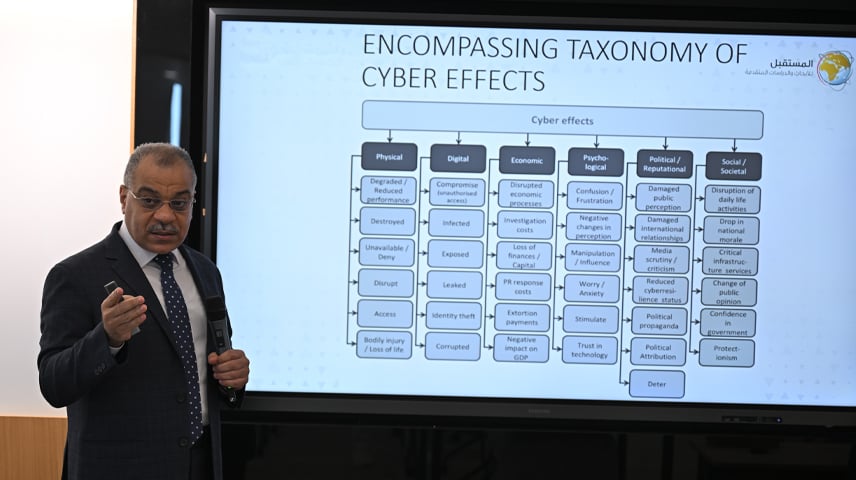
There is no doubt that artificial intelligence (AI) has transformed the entire world, not just national security. This is something that the average user, not necessarily the researcher or specialist in the field, can experience. However, for the academic community to grasp the continuous and escalating impact of AI on various aspects of life, it must first build a foundation in the fundamentals of AI. In this context, the Future Center for Advanced Research and Studies hosted Dr. Adel Abdel Moneim, an international expert in information security, on Wednesday, July 16, 2025, to discuss the impact of AI on national security issues.
Introduction to Artificial Intelligence and Security Issues:
Artificial intelligence (AI) has become a fundamental element in shaping global security strategies, from predictive analytics to autonomous systems. AI is both a powerful tool and a potential threat.
It can be argued that AI systems that learn through trial and error differ fundamentally from automated tools that simply follow pre-programmed instructions. While many current technologies operate autonomously, they are not necessarily classified as true artificial intelligence. As learning systems become increasingly integrated into defense and security, they present both significant opportunities and risks, particularly regarding the potential for machines to make critical decisions without human oversight. This shift necessitates precise definitions, well-defined policies, and international cooperation to ensure the responsible use of these powerful technologies.
Artificial Intelligence and Surveillance Systems:
Using artificial intelligence, scientists have developed advanced surveillance technologies, including facial recognition and behavioral analytics. While effective for law enforcement, these tools also threaten civil liberties and privacy.
Artificial intelligence enhances surveillance systems in terms of speed, accuracy, and the ability to monitor large populations in real time. It can analyze video footage, recognize faces, detect unusual behavior, and predict potential threats using vast amounts of data.
These advancements offer benefits such as improved public safety and streamlined security operations. However, they also raise serious concerns about privacy, misuse, and lack of accountability, especially when used without clear oversight. Strong safeguards and transparent regulations are essential to ensure that these technologies do not undermine civil liberties.
Deepfakes and Disinformation:
AI-generated deepfakes can produce realistic fake videos, contributing to the spread of misinformation and political instability. Nation-states may use deepfakes to influence elections or political decisions.
The BBC reported that Google integrated generative AI into its core search engine through the Generative Search Experience (SGE), enabling users to receive narrative and conversational responses to complex queries instead of just links to sources. These AI-powered summaries draw on multiple web pages to provide coherent and informed answers, improving user efficiency.
However, the early rollout revealed some notable errors—such as the bizarre advice to eat glue or pizza with unusual toppings—prompting Google to refine the feature and restrict its use to health-related searches. As competition intensifies with Microsoft’s AI-enhanced search engine, Google is accelerating its AI roadmap, including a broader rollout of AI-powered search features in 2025.
AI in Counterterrorism:
AI tools analyze communications, behavior, and networks to detect and prevent terrorist activity. While effective, they risk profiling individuals and violating privacy if not managed properly.
The use of AI technologies to monitor communications, behavioral patterns, and social networks is increasing in order to identify and prevent potential terrorist threats. These tools can process massive amounts of data in real time, indicating suspicious activity and helping authorities respond more quickly.
However, without rigorous oversight and ethical guidelines, these systems risk unfairly targeting individuals based on biased algorithms or incomplete information. This raises serious concerns about profiling, misuse of personal data, and violations of civil liberties. Responsible governance is essential to balancing security needs with fundamental rights.
Artificial Intelligence and Nuclear Threats:
Artificial intelligence (AI) enhances the early detection of nuclear proliferation activities through satellite imagery and anomaly detection. However, several recent studies have pointed to overlaps between AI—particularly machine learning—and nuclear weapons systems. These studies have explored scenarios in which AI could exacerbate nuclear risks, such as in early warning systems, strategic targeting planning, or adversaries’ use of AI to gain asymmetric advantages.
Based on these scenarios, the studies have proposed five guiding principles, including:
- Maintaining effective human control over key decisions.
- Evaluating AI within the broader context of a nation’s nuclear posture.
- Recognizing that international restrictions on nuclear AI are largely unenforceable.
- Implementing self-imposed constraints, favoring the use of low-risk, testable AI within a safe range.
- Leveraging AI to enhance human oversight rather than relying solely on it.